

When your practice closes its doors for the evening, your patient communication responsibilities do not end. Deciding how to manage after-hours calls is one of the most critical operational choices you will make. At the heart of this decision are two primary models: a specialized medical answering service and a clinical nurse triage service. While both approaches bridge the gap between your office hours and the next business day, they differ significantly in cost, clinical scope, workflow integration, and day-to-day utility. Understanding these differences ensures you protect your operational budget while keeping your patients safe, heard, and supported around the clock.
Table of Contents
- What Are the Core Differences Between a Medical Answering Service and Nurse Triage?
- Why Is Cost a Deciding Factor for Growing Practices?
- HIPAA Compliance Is About More Than the Credential of the Person Answering
- When Does Nurse Triage Make Sense?
- When Does a Medical Answering Service Make More Sense?
- Why MedConnectUSA Is More Than a Message-Taking Service
- Frequently Asked Questions
What Are the Core Differences Between a Medical Answering Service and Nurse Triage?
When evaluating your after-hours strategy through a nationwide medical answering service or a clinical triage provider, you must look closely at what happens when a patient calls your office after dark.
A traditional medical answering service focuses on live operator intake, message capture, patient identity verification, and precise on-call physician paging according to your custom protocols. Operators use structured medical terminology, manage routine appointment scheduling requests, and screen for urgent red flags, escalating time-sensitive scenarios directly to your on-call provider.
In contrast, a nurse triage service employs licensed Registered Nurses (RNs) who provide active clinical assessment, symptom evaluation, home-care guidance, and formal triage disposition (such as advising whether a patient should visit an emergency department or wait for morning). While both models keep your practice accessible, their underlying workflows and operational impacts diverge rapidly.


Why Is Cost a Deciding Factor for Growing Practices?
For most independent practices, clinics, and health centers, overhead management dictates every operational decision. The financial gap between a standard medical answering service and clinical nurse triage is substantial.
Nurse-led triage commands premium rates, with an average call costing between $15 and $30. You are paying for licensed nursing hours, clinical documentation, and specialized liability coverage. Conversely, a professional medical office answering service creates a structured, practice-defined front end that can handle the 90% of calls that don't require clinical assessment at about 90% lower cost. This represents a massive savings for your operational budget compared to routing every call into a nurse triage workflow.
That distinction matters because most after-hours traffic is not truly clinical. It is administrative and operational: pharmacy requests, appointment questions, insurance concerns, location details, basic scheduling, message intake, and calls that simply need calm, accurate routing. When competitors suggest answering services are “just message takers,” they ignore the operational reality inside most healthcare practices. A specialized medical answering service is often the filter that keeps your clinical resources focused on actual clinical needs.
| Capability | Medical Answering Service | Nurse Triage Service | Layered Model |
|---|---|---|---|
| Primary Function | Structured intake, caller verification, non-clinical resolution, on-call routing, scheduling support | Clinical symptom assessment, RN evaluation, disposition advice | Initial non-clinical routing with direct escalation to RN triage when needed |
| Typical Cost Structure | Predictable monthly plans or competitive per-minute rates; often about 90% lower cost for the 90% of calls that do not require clinical assessment | Average call cost of $15-$30 due to licensed clinical staff | Balanced cost-efficiency with targeted clinical expense |
| Who Handles Most Calls Best | Administrative, pharmacy, scheduling, message intake, routine after-hours workflows | Symptom-based clinical assessment requiring nursing judgment | Practices wanting a front-end filter plus clinical backup |
| Operator Background | Specially trained U.S.-based medical operators | Licensed Registered Nurses (RNs) | U.S. medical operators backed by clinical escalation paths |
| Best Suited For | 24/7 coverage, routine message relay, urgent on-call paging, keeping clinical queues cleaner | High-risk patient populations needing clinical guidance on symptom-heavy calls | Practices wanting optimal cost control and comprehensive care |
HIPAA Compliance Is About More Than the Credential of the Person Answering
A common misconception among practice managers is that clinical staff inherently guarantee superior data security. In reality, HIPAA compliance is a regulatory standard that applies equally to both operational models.
Whether you partner with a clinical triage group or a HIPAA compliant answering service, your vendor must execute a signed Business Associate Agreement (BAA), maintain encrypted message delivery systems, and protect Protected Health Information (PHI) at every stage of the call.
True compliance relies on secure physical facilities, rigorous ongoing staff training, and audited communication pathways. When your patients share sensitive medical information after hours, you need absolute confidence that your partner maintains uncompromised security standards: regardless of whether the person answering is a trained medical operator or an RN.

When Does Nurse Triage Make Sense?
Nurse triage is a powerful tool under specific clinical circumstances. You might consider an RN-led triage model if:
- Your practice manages high-risk patient populations (such as oncology, cardiology, or post-surgical care) where immediate clinical judgment prevents unnecessary emergency room admissions.
- Your physicians require structured clinical documentation and symptom scoring completed before they are interrupted at night.
- Your operational budget easily absorbs higher per-minute clinical fees in exchange for reduced liability around symptom assessment.
When Does a Medical Answering Service Make More Sense?
For the vast majority of primary care providers, dental practices, pediatricians, and multi-specialty clinics, a specialized healthcare answering service represents the ideal balance of reliability and economy. It makes the most sense when:
- You primarily need prompt call answering, accurate message intake, appointment coordination, pharmacy call handling, and dependable on-call provider paging.
- You want a structured, practice-defined front end that resolves or routes 80% to 90% of routine call volume before those calls ever clutter a clinical queue.
- You want to eliminate staff burnout and missed patient calls without incurring exorbitant clinical overhead.
- You prefer a calm, empathetic human voice answering your patients within seconds (<30 second hold times) while adhering strictly to your custom escalation rules.
This is also where the “better care” claim made by some triage-first competitors starts to break down operationally. If non-clinical calls are pushed to a nurse simply because a nurse is available, your true urgent calls wait in the same queue as refill requests, scheduling issues, and routine administrative questions. That does not improve care. It delays clinical attention for patients who genuinely need nursing judgment. A well-run medical answering service protects care quality by separating non-clinical work from clinical escalation instead of blending everything together.
Why MedConnectUSA Is More Than a Message-Taking Service
Since 1991, MedConnectUSA has operated exclusively as a medical-only answering service provider. We do not field calls for plumbing, retail, or legal businesses; our entire infrastructure is dedicated to healthcare communications. That 30+ year focus matters because after-hours patient communication is not generic call handling. It requires disciplined workflows, escalation accuracy, and operators who understand how your practice actually runs.
Our role is not passive message taking. MedConnectUSA functions as a structured, practice-defined front end for your after-hours communication flow. Using your exact protocols, our team handles the large majority of routine calls, including administrative questions, pharmacy-related requests, appointment and scheduling issues, patient identification, message intake, and provider routing. In many practices, that means 80% to 90% of incoming after-hours volume is managed more efficiently without pushing every call into an expensive nurse queue.
That workflow protects patient care. When non-clinical calls are filtered correctly by a specialized medical answering service, your nurses and providers can focus on symptom-based calls that actually require clinical judgment. When every call flows toward a triage model, clinical queues become crowded with work that does not belong there, which can slow response times for patients with truly urgent concerns.
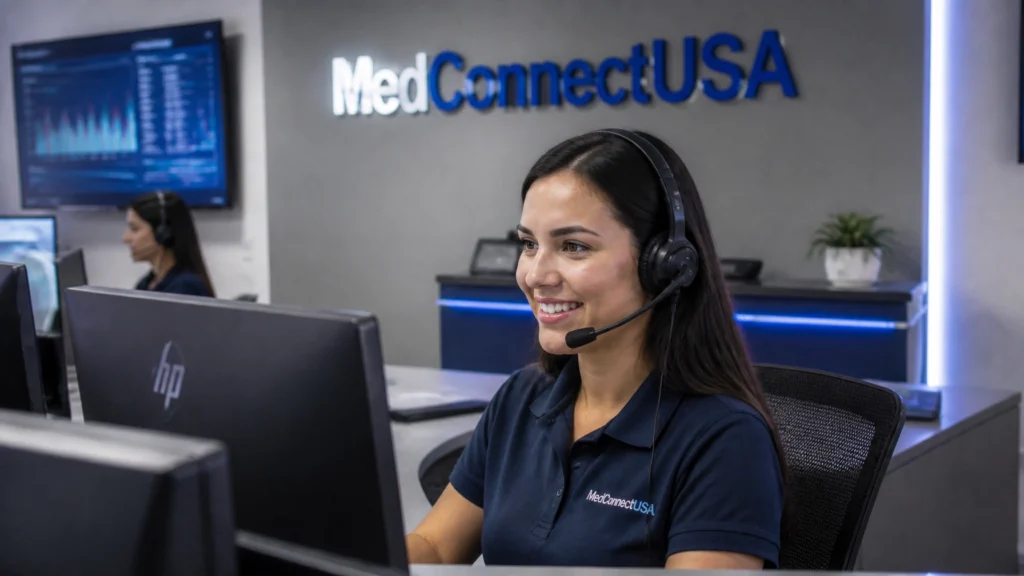
Our operators are 100% U.S.-based, working in secure, supervised call centers rather than remote home offices. That is a major quality and security advantage over decentralized models that rely on home-based staff. Before answering a single live call for your practice, every operator completes more than 90 hours of rigorous initial training, followed by 160 hours of supervised call handling. This ensures complete mastery of medical terminology, compassionate patient communication, and strict HIPAA protocols.
Our commitment to operational excellence has been recognized with the Association of TeleServices International (ATSI) Award of Excellence 23 times, including 20 consecutive years. When you partner with us, you gain a continuity-focused ally equipped with disaster recovery readiness and rapid onboarding to support your practice seamlessly.

Frequently Asked Questions
Are operators medically trained?
While our operators are not nurses or doctors, they undergo extensive training in medical terminology, HIPAA compliance, and customized client triage protocols. They recognize urgent red-flag symptoms and immediately follow your exact escalation pathways to reach your on-call physician. Just as importantly, they are trained to efficiently handle the large volume of non-clinical calls that do not require nursing time, helping keep your clinical queue clear for true urgent concerns.
How quickly are after-hours calls answered?
Our staffing models are engineered around healthcare industry call trends, maintaining average hold times of under 30 seconds to ensure your patients never experience frustrating delays.
Can an answering service integrate with our existing schedule?
Yes. We integrate smoothly with your existing office workflows, supporting secure messaging apps, encrypted email delivery, and direct calendar scheduling based on your practice's preferences.
What is the setup process for a new medical practice?
Our rapid onboarding team can implement your customized call protocols and have your after-hours coverage live within 24 to 72 hours, ensuring zero disruption to your patient care flow.
Secure Your After-Hours Patient Experience Today
Choosing the right after-hours partner transforms patient satisfaction, protects your clinical team from burnout, and ensures your practice remains accessible every hour of the year. Whether you need standard message dispatch or a sophisticated layered communication workflow, having a reliable medical answering service is essential for modern healthcare delivery.
If you are comparing a nurse triage-first model with a structured medical answering front end, the real question is simple: which approach keeps routine calls out of your clinical queue while preserving speed, security, and patient confidence? That is where MedConnectUSA's 30+ years of medical-only experience, 100% U.S.-based supervised centers, and workflow-specific call handling create measurable value for your practice and your patients.
To learn how MedConnectUSA can create a customized after-hours medical answering solution for your practice, contact our team at 888-216-8482 or talk to a specialist.