

For years, the healthcare industry has been stuck in a binary debate: Do you choose the speed and cost-savings of AI, or the empathy and accuracy of a human operator? In 2026, this “either/or” mindset is exactly what’s holding your practice back. True clinical efficiency isn’t found in a chatbot that frustrates patients or a traditional call center that leaves them on hold for ten minutes.
The answer lies in integrated intelligence. At MedConnectUSA, we’ve developed SmartScreen: a system where AI doesn’t act as a barrier to human connection, but as a bridge. It isn’t just a bot. SmartScreen integrates directly into EMRs to help handle appointment scheduling and insurance qualification, including identifying the insurance type, while also supporting the live workflow behind every patient call. By combining advanced AI data processing, sentiment analysis, and our 100% U.S.-based, medically trained operators, we ensure that every call is handled with clinical precision and a human touch. Efficiency isn’t about replacing people; it’s about empowering them to provide better care.
Key Takeaways
- The Binary Trap: Choosing only AI or only human operators creates gaps in patient safety and practice workflow.
- SmartScreen Integration: MedConnectUSA’s SmartScreen is not an “add-on” but a fully integrated system where AI and live experts work in tandem, including direct EMR workflows for scheduling and insurance qualification by type.
- The Competitor Gap: Most “hybrid” models use AI as a gatekeeper to hide outsourced, non-medical staff.
- Clinical Safety: SmartScreen can detect when a caller sounds emotional or upset, while MedConnectUSA’s exclusively medical-trained, U.S.-based operators respond with the right context and professionalism.
- Operational Excellence: Integrated systems deliver <30-second hold times and seamless doctors office answering service support.
Table of Contents
- Why is the ‘AI vs. Human’ Debate the Wrong Starting Point?
- How Does SmartScreen Differ from Standard ‘Hybrid’ Models?
- Can an AI-Only Solution Truly Handle Clinical Complexity?
- What Does ‘U.S.-Based, Medical-Only’ Mean for Your Patients?
- Real-World Scenarios: SmartScreen in Action
- Comparison: SmartScreen vs. The Competition
- Frequently Asked Questions
Why is the ‘AI vs. Human’ Debate the Wrong Starting Point?
If you are looking at AI as a way to “get rid” of answering service costs, or looking at live operators as an “old school” necessity, you’re missing the bigger picture. Clinical efficiency isn’t just about answering a phone; it’s about what happens after the “hello.”
In a high-pressure environment like an internal medicine answering service, a patient calling with chest pain doesn’t want to navigate a “smart” voice menu. Conversely, your staff doesn’t want to spend their morning sorting through thirty voicemails of non-urgent prescription refills.
The “AI vs. Human” debate assumes one must lose for the other to win. In reality, AI is excellent at sorting, prioritizing, and data entry, while humans are essential for triage, empathy, and complex problem-solving. When you separate them, your practice suffers from fragmented communication. When you integrate them, you get the best of both worlds: lightning-fast response times and high-level clinical accuracy.


How Does SmartScreen Differ from Standard ‘Hybrid’ Models?
You’ve likely seen “AI-powered” answering services popping up everywhere. Most of these are “hybrid” in name only. They use AI as a front-end gatekeeper: a digital bouncer designed to keep callers away from live agents for as long as possible to save the company money. When the AI fails (and it often does with complex medical jargon), the call is “failed over” to a live agent.
The problem? That live agent is often an outsourced, non-medical operator working in a generic call center. They have no context of the conversation the patient just had with the AI, forcing the frustrated patient to repeat everything.
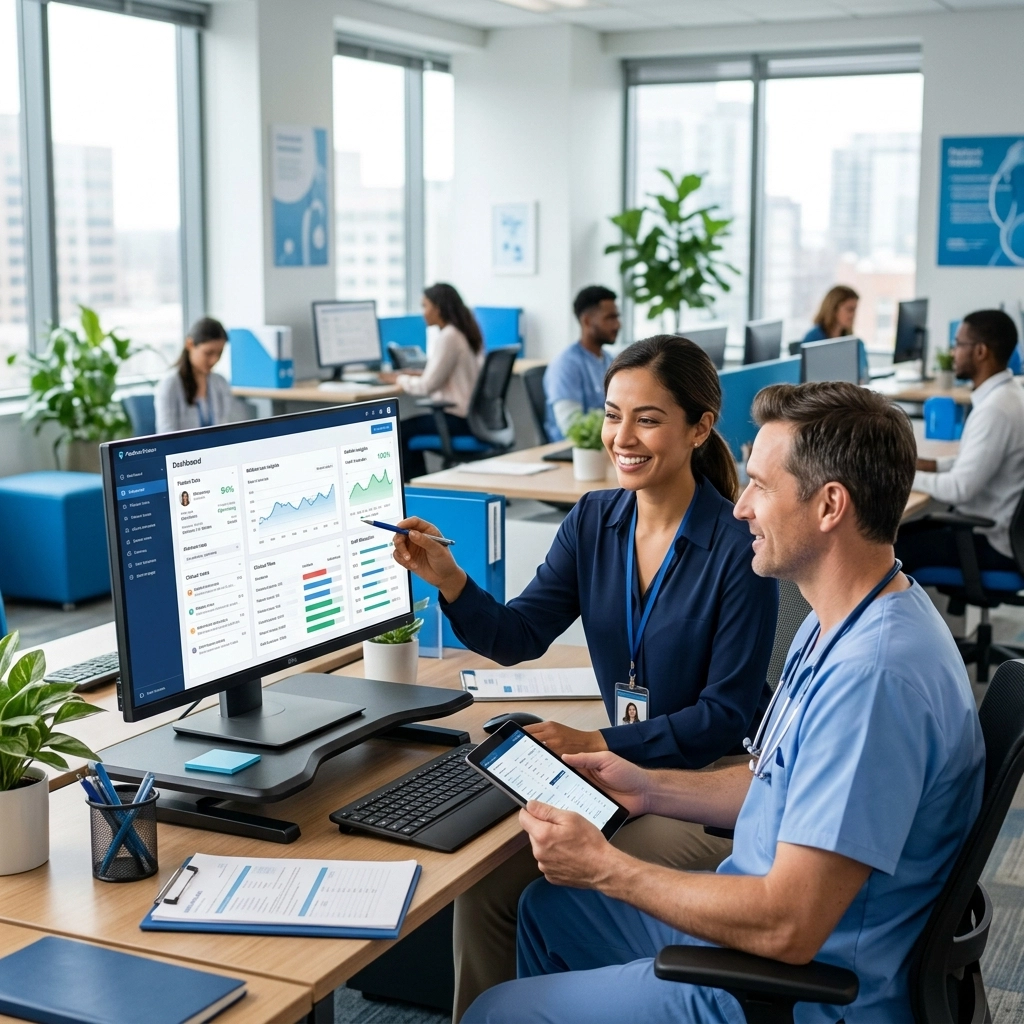
SmartScreen is different. It is a fully integrated system. Our AI works in the background to assist our live, in-house operators. It listens, transcribes, and pulls relevant patient data instantly. It also integrates directly into EMRs to support appointment scheduling and insurance qualification, including identifying the insurance type, so your workflow doesn’t break between the call and the chart. SmartScreen can even use sentiment analysis to detect when a caller sounds emotional, frustrated, or upset and help trigger the right response path. So when our U.S.-based medical professional picks up the line, they aren’t starting from zero. They are already equipped with the context they need to provide a HIPAA compliant answering service experience that feels personal and professional.
Just as important, our “human backup” is not rented from a third party. Unlike other hybrid models that gatekeep access to live help or outsource overflow to generic vendors, MedConnectUSA uses its own in-house, U.S.-based operators. We’ve been medical-only since 1991, and our highly trained specialists are exclusive to our clients. We do not answer for other AI companies. That human + machine synergy is built on over 60 years of IT experience.
Can an AI-Only Solution Truly Handle Clinical Complexity?
AI startups love to talk about “99% accuracy” in laboratory settings. But clinical practice doesn’t happen in a lab. It happens during power outages, during flu season, and when a frantic parent is calling because their child has a 104-degree fever.
Can an AI distinguish between a routine orthopedic answering service inquiry about a follow-up appointment and a post-op patient describing symptoms of a pulmonary embolism? Maybe. But “maybe” isn’t good enough in healthcare.
Our operators have been doing this since 1991. They understand the nuance of a trembling voice. They know the difference between “I’m uncomfortable” and “I’m in respiratory distress.” SmartScreen strengthens that process by flagging emotional cues through sentiment analysis, but AI can only support the interaction; our humans still provide the judgment. This is why we don’t use AI as a gatekeeper; we use it as a tool for our medical-only staff to work more efficiently.
What Does ‘U.S.-Based, Medical-Only’ Mean for Your Patients?
When a patient calls your office after hours, they are often at their most vulnerable. They don’t want a “calm bot” or a script-reader in a different time zone who doesn’t understand the local healthcare landscape.
MedConnectUSA’s commitment to being 100% U.S.-based and medical-only means:
- Contextual Awareness: Our operators understand U.S. insurance, local pharmacy hours, and the standard of care in American practices. That matters when SmartScreen is qualifying coverage and identifying insurance type inside the workflow.
- No Language Barriers: Clear, professional communication that builds trust rather than eroding it.
- Specialized Knowledge: Whether it’s a dental office answering service or a surgical center, our team is trained on the specific terminology of your field.
- Exclusive Medical Staffing: Our in-house specialists are dedicated to MedConnectUSA clients only. We do not lend our operators out as overflow labor for outside AI vendors or “hybrid” platforms.
This specialization is why we can maintain average hold times of less than 30 seconds. Because our team is trained exclusively for medical calls, they don’t have to switch gears from a cable company billing query to a pediatric emergency.

Real-World Scenarios: SmartScreen in Action
Scenario A: The Daytime Overflow
Your front desk is slammed. Three patients are checking in, the phone is ringing off the hook, and a nurse needs to call in a stat order. In a traditional model, those calls go to voicemail: a “confusing maze of voice mail prompts” that patients hate.
With our daytime hours answering service integrated with SmartScreen, the AI identifies the urgency of the incoming calls. It can also work inside the EMR workflow to support appointment scheduling and insurance qualification by type before your front desk ever has to stop what it’s doing. If a caller sounds frustrated, SmartScreen’s sentiment analysis helps flag that tone early so the interaction is handled with more care. Routine billing questions are queued for later, while an urgent patient call is instantly routed to a live MedConnectUSA operator who has your practice’s specific protocol on their screen. The patient feels prioritized, and your on-site staff can breathe.
Scenario B: The Post-Op Emergency
It’s 2:00 AM. A patient who had surgery earlier that day is experiencing unusual swelling. An AI-only bot might try to schedule an appointment for Monday morning. A generic “hybrid” service might put them on a 5-minute hold while they find a “backup” operator.
SmartScreen identifies the “post-op” keyword and triggers an immediate high-priority alert. Our live operator is on the line in seconds, follows your exact “Emergency” protocol, and uses SecureLinx to page the on-call physician with a full transcript of the concern.
Comparison: SmartScreen vs. The Competition
| Feature | MedConnectUSA (SmartScreen) | “AI-First” Startups | Traditional Hybrid Models |
|---|---|---|---|
| Live Operators | 100% U.S.-Based / In-House | None or Outsourced | Often Offshore or Third-Party |
| Training | Medical-Only (Since 1991) | General Algorithms | Mixed Industry (Retail/Medical) |
| AI Role | Collaborative Assistant | Gatekeeper / Barrier | Basic Scripting |
| EMR Workflow | Direct support for scheduling + insurance qualification by type | Limited or separate app | Usually manual |
| Sentiment Analysis | Detects emotional/upset callers and supports response path | Variable | Rare |
| Hold Times | < 30 Seconds | N/A (Bot Answer) | 2 – 5 Minutes |
| Compliance | Full HIPAA/BAA | Variable | Often questionable offshore |
| Human Coverage Model | Exclusive MedConnectUSA specialists; not shared with outside AI vendors | Outsourced or none | Shared pools / backup labor |
| Integration | Seamless with Workflow | Isolated App | Manual Hand-off |
Frequently Asked Questions
Does using AI mean my patients won’t talk to a human?
Quite the opposite. Our AI handles the background tasks, including verifying demographics, identifying call type, supporting appointment scheduling, and helping qualify insurance by type, so that our humans can spend more time actually talking to and helping your patients, rather than typing.
What makes SmartScreen different from other hybrid answering models?
Most hybrid models use AI to delay or deflect callers before handing them to outsourced agents or shared backup teams. SmartScreen works alongside our own in-house operators. Those operators are 100% U.S.-based, medical-only, and exclusive to MedConnectUSA clients. We do not answer for other AI companies, which protects quality and consistency.
Can SmartScreen tell when a patient is upset?
Yes. SmartScreen includes sentiment analysis capabilities that can detect when a caller sounds emotional, distressed, or frustrated. That insight helps support a better handoff and a more appropriate response, but the human operator still makes the judgment call.
How does this improve my practice’s bottom line?
By reducing missed calls and improving triage accuracy, you capture more patient encounters and reduce administrative waste. Our answering service for doctors office plans are designed to scale with your volume.
Is my data secure with SmartScreen?
Absolutely. We are fully HIPAA compliant and provide a Business Associate Agreement (BAA). All data processed by SmartScreen is encrypted and resides within our secure, U.S.-based infrastructure.
The landscape of 2026 demands more than just “answering the phone.” It demands a sophisticated blend of technology and human expertise. Don’t settle for a bot that doesn’t understand medicine, and don’t settle for a call center that doesn’t understand your practice.
If you’re ready to see how the combination of SmartScreen technology and U.S.-based medical operators can transform your patient access and staff productivity, we should talk.
To see how MedConnectUSA can customize a solution for your specific clinical needs, talk to a specialist.