

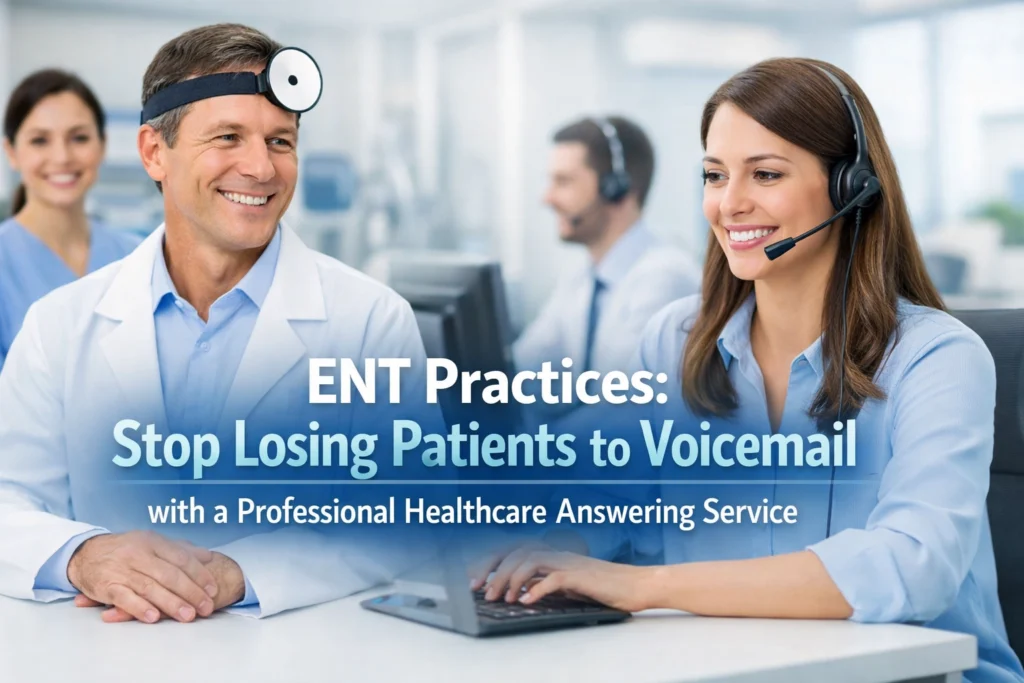
If you’re an ENT practice losing callers to voicemail, the fix is simple: use a specialized, medical-only healthcare answering service that answers live, follows ENT-specific protocols, and routes calls the right way the first time—24/7. That means new patient inquiries get captured, referral calls don’t get mishandled, and post-op concerns get escalated according to your instructions (not a generic script). With MedConnectUSA, you also get operational proof you can rely on: average hold times under 30 seconds, 100% U.S.-based operators in secure call centers, and a medical-only answering service model serving healthcare organizations since 1991. Your workflows stay protected with HIPAA processes and a Business Associate Agreement (BAA) as appropriate—so you can extend coverage without extending risk.
The culprit for most missed opportunities? The "record after the beep" message.
Key Takeaways
- You stop patient leakage when live agents answer and act—not just record messages.
- ENT-specific protocols prevent referral misroutes and post-op escalation delays that generic services often create.
- You can protect patient info with a HIPAA compliant answering service and BAA-aligned workflows.
- 24/7 coverage supports growth by capturing after-hours appointment requests and urgent clinical calls.
- Operational reliability matters: <30s average hold times and 100% U.S.-based operators in secure call centers.
- The right partner acts like an extension of your front desk, following your scripts and on-call rules.
Table of Contents
- Can voicemail cost your ENT practice new patients and referrals?
- How does an ENT-specific answering protocol differ from generic medical answering?
- Can a specialized service manage specialist referrals correctly?
- Can you capture after-hours ENT calls without burning out your staff?
- Does your answering service need to be HIPAA compliant (and provide a BAA)?
- Will outsourcing calls actually improve daytime efficiency and staff morale?
- What happens to patient calls during outages or disasters?
- FAQ: ENT answering service setup, scripts, and onboarding
- How do you evaluate an ENT answering service without overcommitting?
Can voicemail cost your ENT practice new patients and referrals?
Yes—because ENT callers often aren’t “just leaving a message.” They’re trying to solve a problem right now: sudden vertigo, post-op bleeding questions, severe sinus pain, or a parent calling after bedtime about a child’s ear infection. If they hit prompts and a beep, they tend to try the next practice.
What voicemail quietly breaks:
- New patient capture: the caller who’s comparing two ENT offices picks the one that answers live.
- Referral handling: PCP offices and urgent care centers need a fast, accurate handoff—not a mailbox.
- Post-op safety and satisfaction: patients want reassurance and a clear next step, not silence.
When you route overflow and after-hours calls to a dedicated medical call center service that’s built for healthcare, you protect the first impression and keep your schedule and clinical communication moving.


How does an ENT-specific answering protocol differ from generic medical answering?
Generic medical answering tends to treat every specialty the same: capture a message, send it off, and move on. ENT practices don’t work like that. Your calls include specialist referrals, post-op status checks, audiology-related questions, and symptoms that can escalate quickly depending on context.
With MedConnectUSA, your call handling is built around your protocols—so the operator isn’t guessing. You define:
- which calls are routine (e.g., records requests, billing questions)
- which are time-sensitive (e.g., post-op concerns, sudden hearing change, severe dizziness)
- who gets paged, when, and how (your on-call schedule + escalation path)
Operational proof matters here. You’re not sending callers to a generic queue: MedConnectUSA is a medical-only answering service, with average hold times under 30 seconds and 100% U.S.-based operators in secure call centers—so patients and referring offices reach a real person fast.
Specialist ENT protocols vs. generic medical answering (comparison)
| Call type | What a generic answering service often does | What an ENT-focused protocol does (MedConnectUSA-style) |
|---|---|---|
| New patient appointment request | Takes a message for callback | Captures full intake details and routes per your rules; can support scheduling workflows when enabled |
| PCP/Urgent Care referral call | Leaves a voicemail / incomplete message | Confirms referral intent, captures urgency + key details, routes to the right team member |
| Post-op concern after hours | “Call 911” blanket guidance or delayed message | Follows your script: symptom capture + defined escalation to on-call provider |
| Vertigo/dizziness panic call | Records message, sends standard email | Uses your triage questions and escalation instructions to get the right next step fast |
| Insurance/records/admin | Sends everything to clinical staff | Separates admin vs. clinical routing to reduce interruptions |
| PHI handling | Unclear safeguards | Uses HIPAA processes; supports a HIPAA compliant answering service model with BAA as appropriate |
Can a specialized service manage specialist referrals correctly?
Yes—when the service is built around referral workflows, not just message taking. ENT practices depend on accurate referrals from PCPs, urgent care, pediatricians, dental providers, and ED discharge teams. A “close enough” message can create delays, duplicate work, or lost patients.
Here’s what referral-safe call handling typically includes:
- Confirming referral intent (new consult, follow-up, urgent evaluation)
- Capturing the right details (referring provider, call-back number, urgency, brief reason for referral)
- Routing to the correct destination (referral coordinator vs. scheduling vs. clinician)
- Escalating when you say to (e.g., airway-related red flags, sudden hearing change, post-op complications)
This is exactly why many practices choose a medical-only healthcare answering service instead of a generic call center. Your operators follow your playbook, and your referral sources get a confident, professional live answer—fast.
Can you capture after-hours ENT calls without burning out your staff?
If your phones go to voicemail after 5 PM, you’re leaving appointment requests and anxious clinical calls unserved. An after-hours medical answering service keeps you reachable 24/7 while your team actually gets to rest.
A real-world scenario:
- Friday, 8:22 PM: a patient calls with increasing pain and drainage after sinus surgery.
- The operator follows your post-op script, captures key symptoms, and escalates per your on-call schedule.
- Your provider gets the right info the first time—without playing phone tag Monday morning.
When configured, call handling can also support scheduling workflows (or structured message intake) so you walk in to fewer call backs and a cleaner queue.


Does your answering service need to be HIPAA compliant (and provide a BAA)?
If your answering service will touch PHI (and in healthcare, it usually does), you need a partner that treats privacy like an operational requirement—not a marketing claim. Voicemail, consumer texting, and non-medical call centers can create avoidable exposure when messages include names, DOBs, symptoms, medications, or post-op details.
With MedConnectUSA, you’re working with a HIPAA compliant answering service built for healthcare communications. You can also request a Business Associate Agreement (BAA) as appropriate for the services performed.
Practical protections you can expect:
- HIPAA-aligned processes and trained personnel
- Secure options for message delivery through secure messaging
- Consistent workflows in secure call centers with 100% U.S.-based operators
- A medical-only model (not a general business answering service) focused on clinical communication since 1991
For ENT practices, that matters because the “small details” in a message are often the most sensitive—and the most clinically important.
Will outsourcing calls actually improve daytime efficiency and staff morale?
It does when you use it as workflow support, not a band-aid. ENT phones spike during allergy season, post-op clinic days, and any time you have multiple providers running behind. Meanwhile, your front desk is also checking in patients, handling authorizations, scanning referrals, and trying to keep the schedule on track.
A doctors office answering service can take the pressure off in specific, controllable ways:
- Overflow coverage when lines stack up (so patients aren’t stuck on hold)
- Lunch/meeting coverage so your team gets predictable breaks
- Structured message intake that reduces back-and-forth and missing details
- Clear routing rules so clinical interruptions drop
Because MedConnectUSA is built for healthcare, the goal isn’t “answer the phone at any cost.” It’s answer fast (average hold times under 30 seconds), follow your instructions, and keep your in-office team focused on the patients in front of them.

What happens to patient calls during outages or disasters?
If your phones stop working, patients don’t experience it as “an outage.” They experience it as “my ENT office isn’t answering.” That’s a problem during storms, power outages, local internet failures, or even a simple carrier issue.
A specialized answering partner adds continuity through disaster recovery so calls still reach a live agent even when your office can’t take them. For ENT, that’s especially important for:
- post-op patients who aren’t sure what’s normal
- parents calling after hours about acute ear pain
- patients with dizziness who need clear next-step guidance based on your escalation rules
Reliable coverage protects patient experience and reduces clinical risk when the unexpected happens.
FAQ: ENT answering service setup, scripts, and onboarding
How fast can you get my ENT practice live?
Most practices can be onboarded quickly once your call flows, on-call schedules, and scripts are finalized. The goal is to mirror your front desk—without disrupting current operations.
Can you follow our exact triage and post-op scripts?
Yes. Your protocols drive the workflow. We build call handling around your instructions so calls are screened, routed, and escalated the way you want.
Do you only answer after-hours, or can you help during the day too?
Both. Many ENT offices use coverage for overflow, lunch breaks, meetings, and peak seasons—plus 24/7 after-hours coverage.
Can you handle both admin and urgent clinical calls?
Yes—with separation. Your rules can route admin calls one way (billing, records, directions) and clinical calls another (post-op concerns, symptom escalation).
Are you a HIPAA compliant answering service? Do you offer a BAA?
Yes. MedConnectUSA operates with HIPAA-aligned processes and can provide a BAA as appropriate for the services performed. You can also use secure messaging for protected delivery options.
Are your operators U.S.-based?
Yes. MedConnectUSA uses 100% U.S.-based operators working in secure call centers (not home-based).
How do you evaluate an ENT answering service without overcommitting?
A good evaluation focuses on operational fit, not promises. Before you switch anything, pressure-test the basics:
- Do they document and follow ENT-specific scripts (referrals, post-op, urgent symptom escalation)?
- Can they meet speed expectations (like <30s average hold time)?
- Are they truly medical-only, with long-term healthcare experience? (MedConnectUSA has done this since 1991.)
- Do they support a HIPAA compliant answering service workflow and BAA expectations?
- Can they cover both after-hours medical answering service needs and daytime overflow through a healthcare answering service model?
If you want, we can walk through your current call types (new patients, referrals, post-op, admin), map the routing rules, and show you exactly what the operator screen and escalation path would look like—so you can make a confident decision.

To learn more about how we can tailor our services to your ENT clinic's specific needs, talk to a specialist.