

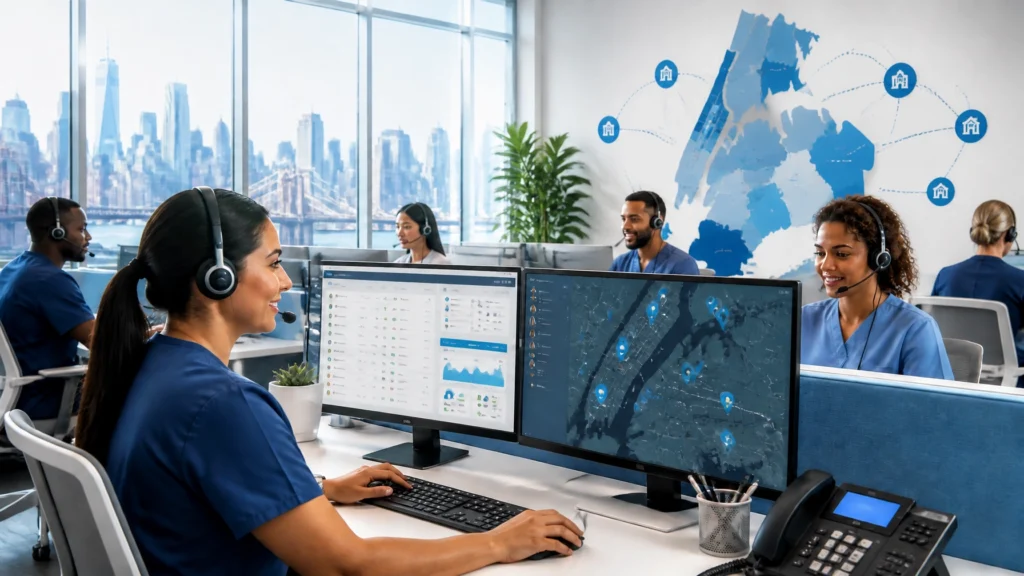
If you manage a medical group with offices in Manhattan, Brooklyn, Queens, the Bronx, or Staten Island, scattered call handling creates friction fast. Patients call the wrong location, front desks get buried, hold times rise, and urgent messages can bounce between teams. A medical answering service new york medical groups use to centralize patient access helps you route calls consistently, reduce front-desk overload, and give patients one reliable path to your practice. For high-volume metro clinics, the goal is not just answering more calls. It is creating a cleaner workflow for scheduling, messages, after-hours coverage, and provider escalation across every site. That is why many organizations serving medical practices in New York look at specialized healthcare answering service support and physician answering services instead of trying to solve multi-location call volume with voicemail and patchwork staffing.
Table of Contents
- Key Takeaways
- Why do New York multi-location medical groups struggle to manage patient calls efficiently?
- How does centralized call handling improve patient access across NYC locations?
- What should a medical answering service New York medical groups use actually handle?
- How is a healthcare answering service different from each office handling its own phones?
- Why do physician answering services matter for after-hours and overflow coverage in New York?
- How should you compare call centralization options for Manhattan, Brooklyn, and other NYC locations?
- What do centralized call workflows look like in real New York practice scenarios?
- FAQ
Key Takeaways
- Multi-location medical groups in New York often lose efficiency when each office handles calls differently.
- A medical answering service new york medical groups choose can centralize patient access, reduce front-desk overload, and create more consistent message routing across locations.
- A specialized healthcare answering service helps you manage scheduling calls, referral questions, after-hours messages, and provider escalation with one structured workflow.
- Physician answering services are especially useful when your Manhattan and Brooklyn offices experience different call peaks but need one reliable patient access process.
- MedConnectUSA is 100% U.S.-based, medical-only since 1991, supports HIPAA-aware workflows, and offers BAA support when appropriate.
- If you are serving medical practices in New York, centralized call coverage can improve patient experience while making your staff’s day more manageable.
Why do New York multi-location medical groups struggle to manage patient calls efficiently?
New York medical groups deal with a volume and pace that smaller markets do not. One office may be managing heavy morning scheduling in Manhattan while another handles lunch-hour overflow in Brooklyn and another fields referral or prescription questions from Queens. When every site answers calls differently, patients feel the inconsistency quickly.
You may already see the symptoms: calls rolling to voicemail, duplicate messages, front-desk staff interrupted during check-in, and patients choosing the wrong location because they are not sure where to call. In a dense metro market, that confusion creates operational drag fast.
A medical answering service new york organizations use for centralized call handling gives your patients a steadier experience. Instead of each office improvising, your group can use one call intake workflow, one message standard, and one escalation path that supports the whole organization.
How does centralized call handling improve patient access across NYC locations?
Centralization improves access because it removes guesswork. Patients do not have to know whether they should call Manhattan, Brooklyn, or a back-office number. They simply reach your practice and get directed correctly.
That matters in New York, where patients expect speed and clarity. If your group spans multiple boroughs, callers may be commuting, calling between work meetings, or trying to schedule around tight availability. A fragmented phone setup makes your practice feel harder to reach than it needs to be.
A structured medical answering service workflow can help you:
- Route callers to the correct location or provider
- Capture new patient inquiries consistently
- Support appointment-related calls when enabled
- Reduce transfer loops between offices
- Escalate urgent concerns based on your on-call instructions
- Create one reliable access point across your group
That kind of process gives patients a cleaner experience and gives your staff more control over the day ahead.
What should a medical answering service New York medical groups use actually handle?
Not every vendor is built for the complexity of a multi-site medical group. When you evaluate a medical answering service new york provider, focus on workflow control, consistency, and healthcare-specific handling.
A stronger setup should include:
- Live answering for multiple practice locations
- Customized call flows by office, specialty, provider, or schedule
- Overflow support during heavy call periods
- After-hours coverage with on-call routing
- Secure message delivery options
- HIPAA-aware processes and BAA support when appropriate
- U.S.-based operators in secure call center environments
- Clear documentation standards for patient messages
- Escalation logic for urgent and routine calls
That matters because centralization only works if the workflow stays organized. If your answer path is inconsistent, one location still ends up cleaning up another location’s backlog.

How is a healthcare answering service different from each office handling its own phones?
Letting each office manage its own phones may seem flexible, but it often creates uneven coverage. One front desk may be excellent at triage and message capture, while another may be overwhelmed by walk-ins, check-outs, and insurance questions. Patients experience those differences immediately.
A specialized healthcare answering service gives you a more controlled system.
| Comparison Point | Each Office Handles Its Own Phones | Centralized Healthcare Answering Service |
|---|---|---|
| Patient experience | Varies by location and staffing | More consistent across the group |
| Call overflow handling | Often limited | Managed through one shared workflow |
| Message quality | Inconsistent between offices | Standardized intake and routing |
| After-hours coverage | Patchwork or voicemail-heavy | Structured live answering and escalation |
| Front-desk interruptions | Frequent | Reduced during busy clinic hours |
| Multi-location visibility | Fragmented | Better aligned across locations |
At MedConnectUSA, we operate as a 100 percent medical answering service. That matters when your group needs operators who understand healthcare communication and can follow location-specific instructions without making the patient work harder.
Why do physician answering services matter for after-hours and overflow coverage in New York?
In a city like New York, your busiest call hours are not always predictable. A Manhattan site may get hit before business hours, a Brooklyn office may see call spikes after lunch, and after-hours messages can come in from any location. If you rely only on in-office staff, those peaks put pressure on the front desk and increase the odds of missed or delayed messages.
That is where physician answering services help. A specialized healthcare answering service can support:
- After-hours live answering
- Daytime overflow coverage
- On-call provider routing
- New patient intake support when configured
- Secure message handling
- Holiday, weekend, and backup coverage
For medical groups serving medical practices in New York, this kind of support is practical. It lets you centralize communication without implying a local office presence. Your calls are still handled nationwide from secure U.S. centers, but the workflow is built around New York patient demand and multi-location operations.

How should you compare call centralization options for Manhattan, Brooklyn, and other NYC locations?
Do not compare options on cost alone. Compare them on whether they actually solve the operational problem.
Use this framework:
| Buying Question | What to Look For |
|---|---|
| Can they support multiple locations? | Office-specific protocols, shared overflow, and centralized intake |
| Do they specialize in healthcare? | Medical-only or deep healthcare workflow experience |
| Can they manage after-hours and daytime overflow? | Yes, with clear escalation rules |
| Are they U.S.-based? | 100% U.S.-based operators in secure call center environments |
| Can they support HIPAA-aware workflows? | Trained staff, secure processes, BAA support when appropriate |
| Will they reduce front-desk interruptions? | Live answering and message capture that protects clinic flow |
| Can they reflect our New York workflow? | Borough-aware routing, provider instructions, and multi-site logic |
If you are comparing vendors, review the New York medical answering service page as part of your evaluation. The right medical answering service new york setup should make patient access simpler, not add another layer of confusion.
What do centralized call workflows look like in real New York practice scenarios?
Here are a few real-world examples that show how centralization helps:
Scenario 1: Multi-specialty group with Manhattan and Brooklyn offices
A new patient calls the Manhattan number but actually wants the earliest available visit at either location. Instead of transferring the caller back and forth, the operator captures the request and routes it according to your scheduling workflow. The patient gets a clearer path, and your front desk avoids another interruption.
Scenario 2: High-volume primary care network in Queens and the Bronx
Morning call volume spikes while staff are checking patients in. Overflow calls are answered live, messages are documented consistently, and routine requests are routed by office. Your in-house team stays focused on the patients in front of them.
Scenario 3: Specialty clinic with providers rotating across sites
A patient needs to reach the physician on call after hours and is unsure which location to contact. The answering team follows the centralized protocol, identifies the correct provider coverage, and routes the message securely. That cuts down on delays and reduces confusion for the patient.
Scenario 4: Downtown Brooklyn office during an internet outage
Your phones still need coverage even when the office workflow is disrupted. A centralized medical answering service gives patients a live answer, captures urgent needs, and helps your group maintain continuity while your team works through the outage.
These are the moments when centralization becomes more than a staffing fix. It becomes part of your patient access strategy.
FAQ
Can MedConnectUSA support medical groups in New York without being physically located in New York?
Yes. MedConnectUSA supports providers nationwide from secure U.S. call centers. We are serving medical practices in New York without implying a local office in the city.
What kinds of organizations benefit most from a medical answering service New York setup?
Multi-location primary care groups, specialty networks, urgent care organizations, physician groups, and other high-volume metro clinics can benefit from a medical answering service new york workflow.
How do physician answering services help reduce front-desk overload?
Physician answering services reduce interruptions by answering routine calls, capturing detailed messages, routing urgent issues properly, and supporting overflow during busy periods so your front-desk staff can stay focused on in-person patient flow.
Is a healthcare answering service only useful after hours?
No. A healthcare answering service can support after-hours calls, lunch breaks, staff meetings, sudden call surges, internet outages, and daytime overflow across multiple locations.
What should you ask before choosing a centralized call partner?
Ask how the service handles multi-location routing, message standardization, after-hours escalation, secure message delivery, HIPAA-aware workflows, BAA support when appropriate, and backup continuity.
If your New York medical group is trying to simplify patient access across multiple offices, centralizing calls can remove friction for both patients and staff. The right medical answering service new york workflow helps you reduce overload, improve consistency, and support a better experience across every location.
To learn how our medical answering service, healthcare answering service, physician answering services, HIPAA compliant answering service, after-hours medical answering service, and medical answering service New York workflows support medical groups serving medical practices in New York and nationwide healthcare organizations, talk to a specialist