

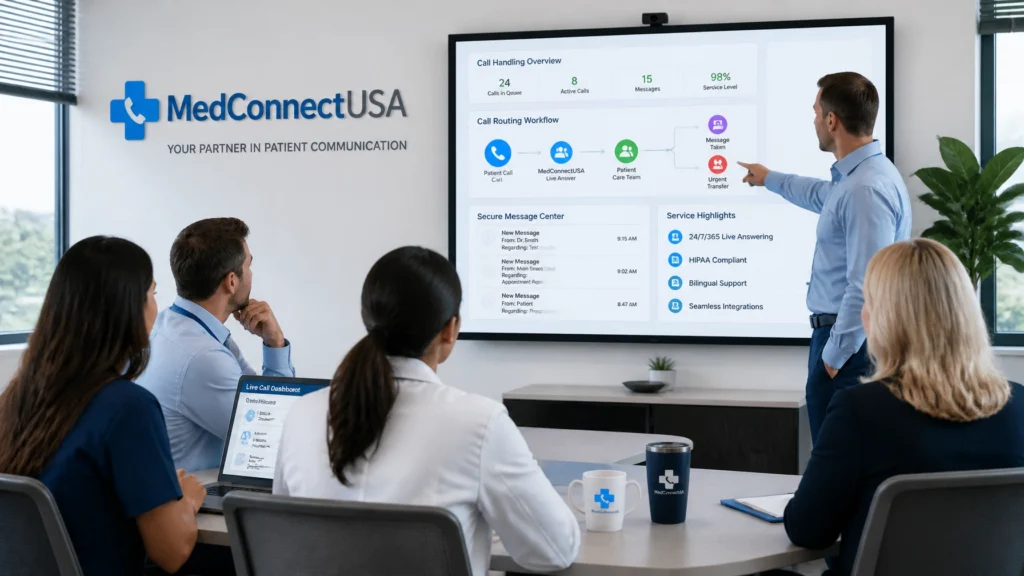
When you schedule a software or operational demonstration with a prospective vendor, it is easy to get swept up in polished sales presentations. However, evaluating a partner to handle your patients requires a rigorous approach. Knowing how to choose an answering service comes down to asking the right technical, operational, and security-focused questions before you sign an agreement. Whether you are running a multi-provider family practice or a specialized clinic, a live demonstration is your single best opportunity to separate generic call centers from a specialized medical answering service built for healthcare workflows. For Monday high-intent buyers comparing vendors, this is where you confirm whether MedConnectUSA can support the exact after-hours, overflow, and escalation workflows your practice depends on.
Table of Contents
- Introduction to Evaluating Your Partner
- Key Takeaways
- H2: Are Your Operators 100% U.S.-Based and Supervised In-House?
- H2: What Exact Training and Onboarding Hours Do Operators Receive?
- H2: How Do You Guarantee Sub-30-Second Hold Times During Peak Hours?
- H2: Can You Walk Us Through Your HIPAA Compliance and BAA Protocols?
- H2: How Do You Handle Custom On-Call Escalation and Complex Protocols?
- Real-World Scenarios to Test During Your Demo
- Frequently Asked Questions
- Conclusion & Next Steps
Key Takeaways
- Demand Proof of U.S. Infrastructure: Insist on 100% U.S.-based, secure, brick-and-mortar call centers rather than dispersed home-based workers.
- Scrutinize Operator Training: Look for rigorous medical-only training programs (often 90 to 160 hours) covering medical terminology, de-escalation, and strict HIPAA privacy.
- Verify Response Times: Test the vendor's ability to maintain sub-30-second hold times during unexpected surges and severe weather events.
- Inspect Security Standards: Ensure comprehensive HIPAA adherence, encrypted message delivery, and executed Business Associate Agreements (BAAs).
- Test Custom Workflows: Do not accept generic scripts; require the vendor to demonstrate real-time handling of your specific on-call escalation paths.
Are Your Operators 100% U.S.-Based and Supervised In-House?
One of the most critical questions you can ask during any vendor demonstration is regarding the physical location and supervision of the personnel answering your patient calls. Many budget-conscious services offshore their operations or rely on unmonitored remote workers operating from home offices. For a medical practice, this introduces unacceptable risks regarding data security, ambient noise, and cultural context.

When evaluating a healthcare answering service, you need absolute assurance that every individual speaking on behalf of your physicians operates in a secure, climate-controlled, brick-and-mortar U.S. facility. In-house supervision ensures that managers monitor calls in real time, enforce strict clean-desk policies, and maintain continuous quality control. At MedConnectUSA, we have operated with 100% U.S.-based, secure call centers since 1991, ensuring your patients always experience a calm, steady voice and professional care.
What Exact Training and Onboarding Hours Do Operators Receive?
General answering services employ agents who handle plumbing contractors, floral deliveries, and legal intake all in the same shift. This lack of specialization leads to confusion, mispronounced clinical terminology, and frustrated patients.
During your demonstration, ask point-blank: What is the prerequisite medical training for your staff, and how many hours of classroom and simulation training do operators complete before taking live healthcare calls?
Top-tier providers require rigorous onboarding: frequently between 90 and 160 hours of focused training: covering medical terminology, empathetic patient de-escalation, insurance literacy, and strict confidentiality protocols. This level of preparation ensures that when a worried parent calls your doctors' office answering service at 2:00 AM, the person on the other end understands clinical urgency and responds with precision.
How Do You Guarantee Sub-30-Second Hold Times During Peak Hours?
A beautiful software interface means nothing if callers languish in an endless phone queue. When evaluating a prospective vendor, ask to see their historical queue analytics and redundancy measures.
You should specifically ask: What is your average speed of answer during peak evening hours or severe weather surges?
A reliable partner must maintain sub-30-second hold times consistently. Ask how their multi-level backup systems and disaster recovery protocols kick in during regional power outages or unexpected call volume spikes. By maintaining robust staffing models and advanced call-routing technology, a specialized medical office answering service ensures that no patient call goes unanswered, protecting your reputation and patient satisfaction scores.
Can You Walk Us Through Your HIPAA Compliance and BAA Protocols?
Regulatory compliance is non-negotiable in healthcare. Never settle for vague assurances that a company "follows privacy rules." You must ask detailed questions about their security architecture, data encryption in transit and at rest, secure message delivery options, and whether they execute a formal Business Associate Agreement (BAA).

Ask the demonstrator to show you how Protected Health Information (PHI) is transmitted from their operators to your on-call physicians. Does it rely on unsecured standard SMS text messages, or does it utilize an encrypted secure messaging solution that meets strict HITRUST and HIPAA guidelines? Ensuring end-to-end security protects your practice from costly compliance violations and gives your patients peace of mind.
How Do You Handle Custom On-Call Escalation and Complex Protocols?
Every medical specialty: from pediatrics and cardiology to orthopedics and dental surgery: has unique communication requirements. During the demonstration, request a live walkthrough of how the vendor implements custom call protocols.
Ask: Can you configure different escalation paths for routine appointment inquiries, urgent clinical symptoms, and hospital referrals?
Avoid vendors who attempt to force your practice into a rigid, one-size-fits-all script. A true partner builds customized workflows that match your exact daytime and daytime hours answering service requirements, ensuring that on-call doctors are only disturbed for true clinical emergencies according to your exact rules. You can explore our case studies to see how tailored workflows transform practice efficiency.
Real-World Scenarios to Test During Your Demo
To truly evaluate how a prospective service will perform under pressure, do not rely on standard PowerPoint slides. Instead, present the vendor with real-world scenarios during your demonstration:
- The Severe Weather Surge: “A major power outage hits our region, and our office phone lines roll over to you simultaneously with a 300% surge in call volume. Walk me through how your operators maintain sub-30-second hold times and route urgent messages.”
- The Distressed Patient: “A patient calls after hours experiencing severe postoperative pain, but they are confused and hesitant to speak clearly. How does your operator de-escalate the caller while swiftly initiating our on-call physician escalation path?”
- The Multi-Location Specialty Group: “We operate three different specialty clinics with separate on-call provider rosters for each location. Show us how your system identifies the correct clinic and routes the message to the right doctor instantly.”
Testing these operational workflows reveals whether the vendor possesses the maturity and sophistication your practice requires. For specialized practices looking for seamless patient support, integrating solutions like our Ready Assist service ensures comprehensive operational backing.
Frequently Asked Questions
What should I look for when evaluating a medical answering service demo?
Look for medical-only specialization, 100% U.S.-based brick-and-mortar call centers, transparent sub-30-second hold time metrics, deep customization capabilities, and verifiable HIPAA compliance backed by a signed BAA.
Why is medical specialization more important than a general business answering service?
General answering services lack clinical vocabulary training, leading to miscommunication on urgent health matters. A medical-only provider understands clinical triage, patient empathy, and the strict confidentiality required in healthcare communications.
How do I verify that a service is truly HIPAA compliant?
Ask to review their technical security documentation, encryption standards for message delivery, employee background check procedures, and ensure they are willing to execute a Business Associate Agreement (BAA) specific to your practice.
Can an answering service integrate with our existing EHR or on-call scheduling software?
Yes. Advanced medical answering providers support seamless integrations with modern scheduling platforms and secure messaging apps, ensuring patient notes and urgent pages reach your clinical team instantly.
Conclusion & Next Steps
Choosing the right communication partner is one of the most impactful operational decisions your practice will make. By asking probing questions during your demonstration: focusing on U.S.-based supervision, rigorous operator training, sub-30-second hold times, and uncompromised HIPAA security: you protect your patients, reduce staff burnout, and ensure seamless continuity around the clock.
With over three decades of medical-only expertise since 1991, we understand the nuances of healthcare communication. Read our patient success stories to see how dependable communication elevates patient trust.
To learn how MedConnectUSA can create a customized after-hours medical answering solution for your practice, talk to a specialist.