

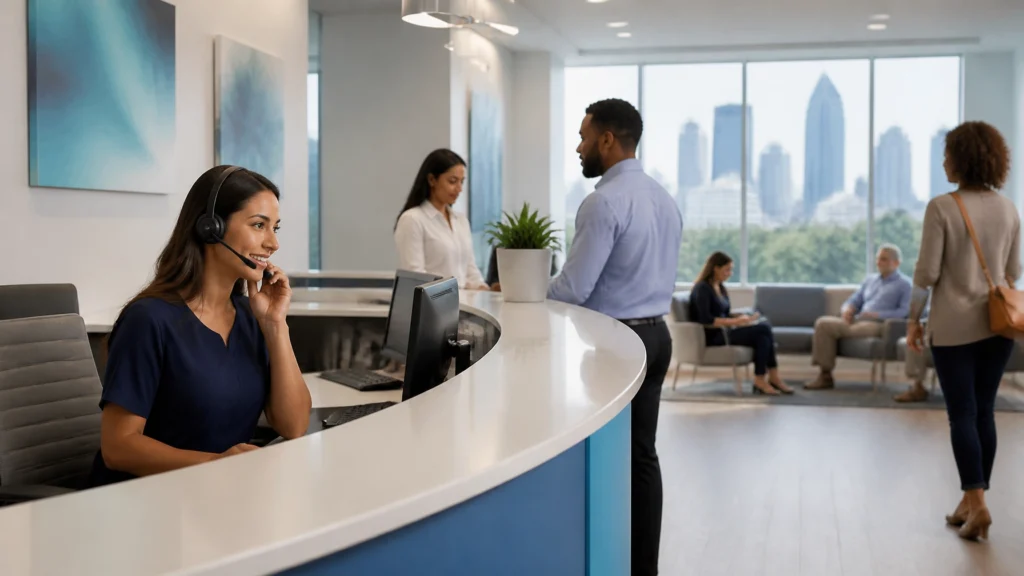
The most effective way to reduce front-desk call overload is to separate routine call handling from clinical and administrative work. A medical answering service Dallas practices can use during business hours captures overflow calls, schedules appointments when authorized, records accurate messages, and escalates urgent matters according to your protocols. The same live coverage can continue after hours, on weekends, and during holidays.
That matters in a fast-growing market where patients expect quick answers, convenient scheduling, and clear follow-up. MedConnectUSA serves medical practices in Dallas nationwide from secure U.S.-based centers: not from a Dallas office: with trained operators, HIPAA-compliant processes, and customized call workflows.
Table of Contents
- What is causing call overload at Dallas medical practices?
- How can daytime overflow coverage protect your front desk?
- What should a Dallas medical answering service do with each call?
- How does after-hours coverage improve patient communication?
- Which call-handling model fits your practice?
- What does this look like in a real Dallas practice?
- What should you ask before choosing a healthcare answering service?
- What are the most common questions about medical answering services?
- What are the key takeaways for your practice?
What is causing call overload at Dallas medical practices?
Your front desk may be handling check-ins, insurance questions, referral coordination, prescription requests, appointment changes, portal questions, and ringing phones at the same time. During lunch breaks, staff meetings, and peak morning hours, even a well-run office can create a confusing maze of voicemail prompts and long hold times.
Dallas practices face additional access pressure because the DFW region continues to grow rapidly. Recent regional healthcare reports place the area’s population above 8 million, with outpatient demand expanding as new residents seek primary care, specialty care, diagnostics, and follow-up services.
The North Dallas Medical District and the broader Dallas Medical District also serve patients moving through complex referral patterns. A patient may call after receiving a referral, while another needs help reaching a specialist, confirming preparation instructions, or finding the right appointment type. If no one answers, the patient may call another practice or delay care.
A reliable medical call center service gives your in-house team room to focus on the patient in front of them while every caller still receives a professional response.
How can daytime overflow coverage protect your front desk?
Daytime coverage isn’t only an after-hours issue. Your busiest call periods often occur while your office is open: especially at the start of the workday, after lunch, and when a provider is running behind.
A daytime medical answering service Dallas practices can customize acts as an extension of your front desk. Operators can follow your instructions to:
- Answer calls when all in-house lines are busy
- Identify the caller and reason for the call
- Provide approved office information
- Take complete messages
- Route scheduling requests to your designated team
- Handle appointment confirmations or changes when enabled
- Capture referral-related questions
- Escalate urgent messages to the correct provider or staff member
- Maintain a consistent response during meetings, lunch, and staff shortages

The goal isn’t to remove your staff from patient communication. It’s to prevent every interruption from landing on the same small team. When calls are answered promptly, your staff can complete check-in, rooming, documentation, and referral work with fewer distractions.
MedConnectUSA’s daytime hours answering service is designed for this type of overflow support. You can use live answering during selected periods, all business hours, or alongside your existing phone system.
What should a Dallas medical answering service do with each call?
Call volume only improves your operation when the information is accurate. A rushed or incomplete message simply moves the problem to another employee.
Your answering workflow should define the exact information operators collect. Depending on your specialty and instructions, that may include:
- Caller identification: Full name, callback number, and patient relationship when relevant.
- Reason for calling: Scheduling, referral, prescription request, billing question, records request, or clinical concern.
- Timing: Whether the request is routine, time-sensitive, or urgent under your approved protocol.
- Preferred response: Call back, secure message, portal response, appointment request, or provider escalation.
- Routing details: The correct department, provider, on-call clinician, or backup contact.
- Documentation: Date, time, operator notes, and any required reference information.
Operators should not diagnose, improvise medical advice, or decide urgency outside your approved instructions. Their role is to identify the purpose of the call, document it clearly, and follow the escalation path you establish.
A well-structured message allows your staff to act without calling the patient back simply to ask, “What was this regarding?” That saves time and helps patients feel prioritized and respected.
For practices that need broader coverage, medical office answering service support can be configured around your specific call protocols rather than a generic script.
How does after-hours coverage improve patient communication?
Your patients don’t stop needing communication when the office closes. They may need to report a post-procedure concern, confirm an appointment time, request a callback, or understand what to do before the next business day.
Dallas traffic and long travel times can make delayed communication especially frustrating. A patient who has spent significant time reaching your office may not want to repeat the same call through several voicemail menus. A calm, steady voice helps them understand that their message has been received and routed correctly.
An after-hours medical answering service can provide:
- Live answering at night, on weekends, and during holidays
- Client-specific scripts and call protocols
- On-call provider escalation
- Backup escalation if the first contact doesn’t respond
- Accurate message delivery through approved secure channels
- Documentation of call time and escalation attempts
- Coverage during storms, power outages, and unexpected office closures

MedConnectUSA is a medical-only provider established in 1991. Its stated operating model uses 100% U.S.-based personnel in secure call centers, HIPAA-compliant processes, secure communications, and Business Associate Agreements when appropriate to the services performed.
For a closer look at the broader model, review MedConnectUSA’s nationwide medical answering service options. Nationwide coverage lets your practice maintain the same protocols during local disruptions without suggesting that the answering company operates a physical office in Dallas.
Which call-handling model fits your practice?
Different practices need different levels of support. The right model depends on call volume, staffing, urgency, and how much work your team can safely absorb.
| Call-handling model | Best use | Main limitation |
|---|---|---|
| In-house staff only | Lower-volume practices with stable staffing | Calls go unanswered during check-in, lunch, meetings, and absences |
| Voicemail | Simple routine requests outside office hours | Patients may become frustrated and urgent messages can be delayed |
| Live overflow coverage | Busy daytime periods and recurring call surges | Requires clear protocols and defined routing |
| Full 24/7 live answering | Practices needing continuous access and escalation | Requires a more complete onboarding process |
| Hybrid live and voicemail model | Routine calls plus live support for selected workflows | Must clearly define which calls receive each response |
A hybrid plan may be enough for a practice that wants live daytime overflow and live urgent escalation after hours while directing non-urgent administrative requests to a secure message queue. Other practices may need a full healthcare answering service for every call outside the front desk’s capacity.
MedConnectUSA also offers Ready Assist, which can support a more structured response when your team needs a defined way to manage calls, messages, or coverage changes.
What does this look like in a real Dallas practice?
Imagine a multi-provider practice near a major Dallas healthcare corridor on a Monday morning. The front desk is checking in patients, a referral coordinator is confirming specialist documentation, and a provider is preparing for a full clinic schedule.
At 8:15 a.m., several calls arrive at once:
- One patient wants to move a routine follow-up.
- A referring office needs confirmation that records were received.
- A new patient needs the correct appointment type.
- A current patient reports a concern that requires provider review.
Instead of sending every call to voicemail, the overflow operator identifies each request, follows the practice’s script, records complete details, and routes the provider-related message according to the escalation schedule. The front desk continues checking in patients without repeatedly stopping to answer the phone.
At 6:30 p.m., another patient calls after a procedure. The operator confirms the caller’s information, follows the approved after-hours protocol, and contacts the designated on-call provider. The operator doesn’t diagnose or promise an outcome; the operator makes sure the concern reaches the right person.
That workflow protects staff attention during the day and gives patients a dependable communication path after hours.

What should you ask before choosing a healthcare answering service?
Before selecting a partner, ask specific operational questions rather than relying on broad promises:
- Are operators trained specifically for healthcare communication?
- Are staff 100% U.S.-based and working in secure call centers?
- Does the provider support HIPAA-compliant processes and offer a BAA when appropriate?
- Can the service follow your exact provider escalation schedule?
- How are urgent calls distinguished from routine messages?
- What happens if the first on-call provider doesn’t answer?
- Can the service cover daytime overflow as well as after-hours calls?
- How are messages delivered and protected?
- Can you review call records and update protocols?
- What answering-time benchmark does the service maintain?
MedConnectUSA reports sub-30-second answering targets, live coverage 24/7/365, medical-only experience since 1991, and rapid onboarding. You can also review its services overview and answering service for doctors’ offices to compare workflows relevant to your practice.
What are the most common questions about medical answering services?
Can a medical answering service handle calls while my office is open?
Yes. Daytime overflow coverage can answer calls when your staff is assisting patients, handling referrals, attending meetings, taking lunch, or managing an unexpected surge.
Can operators schedule appointments?
They can when appointment scheduling is included in your configuration and your practice provides the necessary rules, availability, and restrictions. Otherwise, operators can capture a complete scheduling request for your team.
How does provider escalation work?
Your practice defines the escalation path. The operator identifies the concern, records the required details, contacts the designated provider, and follows backup instructions if the first contact doesn’t respond.
Is a live answering service better than voicemail?
For practices where patients need reassurance, timely routing, or urgent escalation, live answering provides a more responsive experience. Voicemail may still work for routine, non-urgent requests when the instructions are clear.
Does MedConnectUSA have a Dallas office?
MedConnectUSA provides service to Dallas practices nationwide from secure U.S.-based centers. The service does not depend on a physical Dallas office to deliver local call protocols, professional live answering, or Dallas-focused support.
What are the key takeaways for your practice?
- A medical answering service Dallas practices use can reduce interruptions during both business hours and after hours.
- Daytime overflow coverage protects front-desk staff from call surges during check-in, lunch, meetings, and referral work.
- Accurate messages require defined fields, clear routing, and instructions that operators can follow without improvising.
- Provider escalation should include a primary contact, backup contact, timing rules, and documented attempts.
- Dallas’s growth, traffic, referral complexity, and rising expectations make responsive communication a competitive advantage.
- Look for medical-only experience, HIPAA-compliant processes, a BAA when appropriate, secure U.S.-based operations, and measurable answering performance.
- A hybrid plan can combine live answering, secure messages, appointment support, and after-hours escalation around your actual workflow.
If your front desk is losing time to ringing phones and your patients are waiting in a confusing maze of voicemail prompts, a structured live-answering plan can give your team breathing room while keeping communication dependable. talk to a specialist