

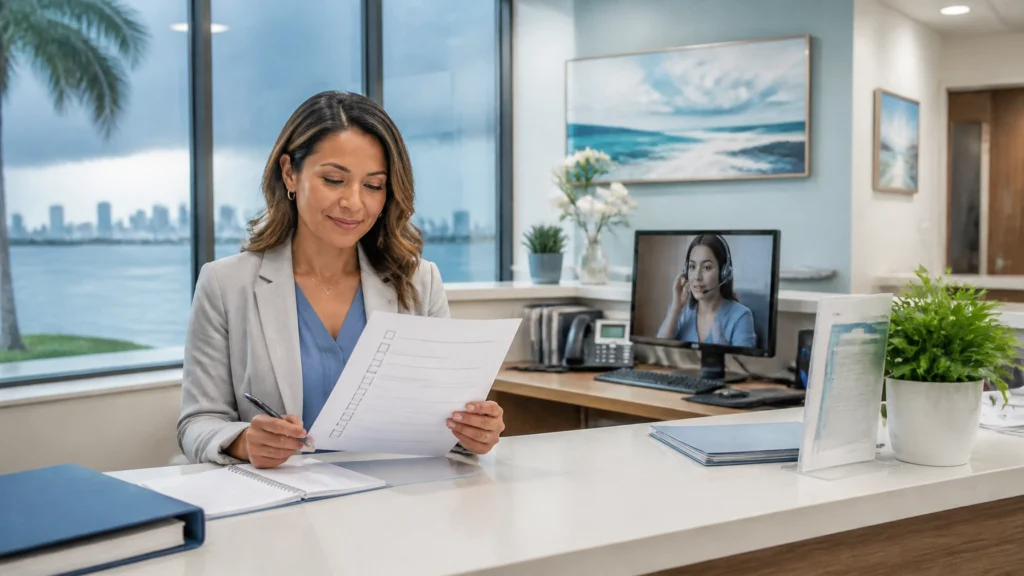
When severe weather threatens Miami, your practice needs more than a closure notice. You need a reliable plan for answering patient calls, communicating schedule changes, routing urgent messages, and managing sudden call spikes when power, roads, or connectivity are disrupted.
A specialized medical answering service Miami practices can rely on provides live coverage from secure U.S.-based centers. MedConnectUSA supports medical practices nationwide with 24/7/365 live answering, secure message delivery, customized escalation protocols, and disaster-readiness support: without implying a physical office in Miami.
This approach helps you protect patient access, reduce staff interruptions, and keep your practice reachable before, during, and after a storm.
Which questions does this guide answer?
- Why does storm continuity matter for patient access in Miami?
- How can you keep patient calls moving during a disruption?
- What should your office closure communication include?
- How does a medical answering service support disaster recovery?
- Which workflows should you establish before hurricane season?
- How do you compare live answering, voicemail, and automated options?
- What questions should you ask before choosing a healthcare answering service?
Why does storm continuity matter for your Miami practice?
Hurricane-season disruptions don’t always begin with a direct impact. Heavy rain can flood roads, power failures can affect office systems, and connectivity problems can make it difficult for patients to reach your staff. Miami-Dade County warns that hurricanes can cause widespread power outages and communication failures lasting days, weeks, or longer. You can review local preparation guidance through the Miami-Dade hurricane readiness resources.
For your patients, a disruption can create immediate uncertainty:
- Is the office open?
- Has an appointment been canceled?
- Where should a medication question go?
- How can a patient reach the on-call provider?
- Is a delayed response administrative: or urgent?
Patients may already feel frustrated, anxious, or physically uncomfortable. A confusing maze of voicemail prompts can make them feel forgotten at the exact moment they need reassurance. Your team may also be dealing with power loss, remote-work complications, staff shortages, and a flood of calls from patients trying to confirm what happens next.
A continuity plan gives callers a calm and steady voice while your clinical team focuses on safety and essential care.
How can you keep patient calls moving during a storm disruption?
Your call plan should separate routine requests from urgent or time-sensitive messages. A trained operator can identify the caller, determine the purpose of the call, collect the required information, and follow your written instructions for routing and escalation.
For example, your workflow may direct operators to:
- Confirm the patient’s name, date of birth, callback number, and reason for calling.
- Explain whether the office is open, closed, operating remotely, or working with limited hours.
- Reschedule appointments according to the availability you provide.
- Send routine messages through an approved secure channel.
- Contact the appropriate on-call provider for urgent issues.
- Escalate unanswered provider calls according to a backup sequence.
- Direct emergencies to emergency services without attempting to diagnose or triage beyond your approved protocol.
This is the practical value of a medical answering service built around your instructions rather than a generic script. Your team defines the rules; our operators follow them consistently.
A strong plan also includes overflow coverage. Even if your office remains open, call volume can rise sharply during lunch breaks, staff meetings, early closures, power fluctuations, or the first business day after a storm. Overflow answering prevents patients from being abandoned in a long queue while your front desk manages the people already in the building.
What should your storm-related closure communication include?
A closure message should be short, specific, and updated as conditions change. It should answer the questions patients are most likely to ask without forcing them through several menus.
Your approved message may include:
- Whether the office is closed or operating on a limited schedule
- The date and expected time of reopening, if known
- Instructions for canceled or postponed appointments
- How patients should request prescription-related assistance
- How urgent calls are routed after hours
- Whether telehealth visits are continuing
- What patients should do if they have a medical emergency
- When the next update will be posted
Your answering partner can use different scripts for the storm approach, active disruption, and recovery period. That prevents yesterday’s closure message from remaining active after your schedule changes.
Your after-hours medical answering service can also continue delivering the same instructions overnight, on weekends, and during holidays. Patients receive consistent information even when your in-office staff is unavailable.
How does a medical answering service support disaster recovery for medical practices?
Disaster recovery for medical practices includes more than restoring computers and reopening the building. It also includes restoring dependable communication with patients, caregivers, referral partners, pharmacies, and on-call clinicians.
MedConnectUSA’s service model supports continuity through:
- 24/7/365 live answering: Patients can reach a live operator when your staff is unavailable.
- Customized call protocols: Operators follow your instructions for scheduling, messaging, routing, and escalation.
- Secure message delivery: Patient information is handled through HIPAA-compliant processes and approved secure channels.
- U.S.-based operations: Operators work from secure U.S. call centers rather than home-based or offshore locations.
- Business Associate Agreement: A BAA is available as appropriate for the services performed.
- Backup and disaster-readiness planning: Call coverage is structured to help maintain service during outages and disruptions.
- Medical-only experience: MedConnectUSA has focused exclusively on healthcare communications since 1991.
For practices reviewing technology-assisted communication, SecureLinx secure messaging can help you evaluate safer alternatives to ordinary texting when messages include protected health information.
The goal isn’t simply to “answer the phone.” The goal is to preserve a dependable path to the right next step when your normal office workflow is unavailable.
Which workflows should you establish before hurricane season?
Build your storm protocol while your team has time to review it: not while rain is entering the parking area and the phones are already ringing.
Your written protocol should identify:
| Workflow area | Decisions to make before disruption |
|---|---|
| Office status | Who authorizes closure, delayed opening, or remote operations? |
| Patient messaging | What exact language explains the current status? |
| Appointments | Who reschedules visits, and which visits receive priority? |
| Urgent calls | Which provider is contacted first, and what is the backup path? |
| Telehealth | What happens if video or broadband service is unavailable? |
| Secure routing | Which message channel is approved for patient information? |
| Staff escalation | Who receives operational alerts if the primary contact is unreachable? |
| Recovery | When and how is the normal call process restored? |
Review the protocol for routine administrative calls as well as clinical escalation. Patients may call about appointments, referrals, billing questions, medical records, prescription requests, or symptoms. Each category needs a defined destination.
If your practice serves patients with heightened anxiety or time-sensitive needs, the HIPAA-compliant answering service guidance for mental health providers offers a useful example of why tone, privacy, and escalation instructions must work together.
What happens in a local storm-disruption scenario?
Imagine a storm system brings heavy rain and flooding to Miami. Your practice closes at noon after staff members report unsafe travel conditions. Several patients are scheduled for the afternoon, an infusion-related question arrives, and a caregiver calls about a worsening symptom. At the same time, your website and phone system are receiving more traffic than usual.
Without a continuity plan, your front desk may spend hours recording messages, repeating the closure notice, and trying to determine which calls require a provider response. Patients wait without knowing whether anyone received their information.
With a live answering workflow, the operator:
- Activates your approved closure script.
- Confirms the caller’s identity and callback information.
- Separates appointment changes from urgent messages.
- Sends routine requests through the approved secure channel.
- Follows the on-call escalation sequence for time-sensitive concerns.
- Repeats emergency instructions when appropriate.
- Records each interaction for your team’s follow-up.
That process helps patients feel prioritized and respected while reducing the number of interruptions your staff must manage during a stressful event.
How should you compare storm-continuity call options?
Not every answering solution provides the same level of operational support.
| Option | Strengths | Limitations during a disruption |
|---|---|---|
| In-office staff only | Familiar team and direct access to systems | Vulnerable to closures, staffing shortages, power loss, and call spikes |
| Voicemail only | Inexpensive and easy to activate | Patients may wait without reassurance or clear escalation |
| Generic answering service | May provide basic message taking | May lack healthcare-specific privacy training and clinical workflows |
| Automated system only | Handles predictable information requests | Can frustrate patients with complex, urgent, or emotional concerns |
| Specialized medical answering service | Live operators, secure handling, customized protocols, overflow, and after-hours coverage | Requires careful onboarding and regular protocol updates |
A specialized healthcare answering service is most useful when it operates as an extension of your workflow: not as a disconnected call center.
Ask about live pickup performance, escalation reliability, secure messaging, backup systems, operator training, and how quickly your team can update scripts. You should also ask whether the provider can document service expectations, including response standards such as hold times under 30 seconds when applicable to the selected program.
What should you ask before choosing a healthcare answering service?
Before you select a partner serving medical practices in Miami, ask:
- Are operators 100% U.S.-based?
- Do operators work in secure call centers?
- Is the service focused exclusively on healthcare?
- Are HIPAA-compliant processes and secure message delivery included?
- Is a BAA available for the services performed?
- Can the provider follow our exact storm closure and escalation instructions?
- How are urgent calls routed if the first provider does not answer?
- Can the service handle sudden daytime overflow?
- Can we use live answering, voicemail, or a hybrid model?
- How are protocols updated when schedules or on-call rotations change?
- What backup systems support continuity during power or connectivity disruptions?
You can also review how MedConnectUSA approaches healthcare communication through its medical answering service resources and specialty workflow examples, including dental emergency call handling.
What are the key takeaways for Miami practices?
- Storm readiness includes patient communication, not just physical facility preparation.
- Flooding, power loss, and connectivity failures can create sudden call spikes.
- A live medical answering service Miami practices use can provide consistent coverage during closures, lunch breaks, meetings, and after-hours periods.
- Your operators should follow written instructions for appointment changes, message intake, secure routing, and urgent escalation.
- Closure scripts should explain what is happening, what patients should do next, and when they can expect another update.
- Disaster recovery for medical practices should include dependable patient access from secure U.S.-based centers.
- MedConnectUSA provides nationwide coverage, with medical-only service since 1991, HIPAA-compliant processes, secure messaging, and BAA support as appropriate.
What questions do practices ask about storm call coverage?
Can a medical answering service take over when our office closes unexpectedly?
Yes. With an approved protocol, operators can activate your closure message, handle incoming calls, document requests, and route urgent messages according to your escalation plan.
Can the service support us while our office remains open?
Yes. Overflow coverage can help during sudden call spikes, staff shortages, meetings, lunch breaks, or periods when your front desk cannot answer every call promptly.
Can operators schedule appointments after a storm?
Appointment scheduling can be configured when your practice enables it and provides the required scheduling instructions, availability, and restrictions.
Does nationwide coverage mean the service has a Miami office?
No. MedConnectUSA serves medical practices in Miami nationwide from secure U.S.-based centers. The service does not require a physical office in the city to provide local workflow support.
Can a healthcare answering service replace emergency care?
No. Operators follow your approved communication and escalation instructions. They don’t diagnose patients or replace emergency services. Your protocol should clearly direct callers with emergencies to the appropriate emergency resource.
A storm-ready call plan gives your patients a reliable way forward and gives your staff room to focus on safe recovery. When you’re ready to review coverage, routing, and disaster-continuity options, talk to a specialist.