

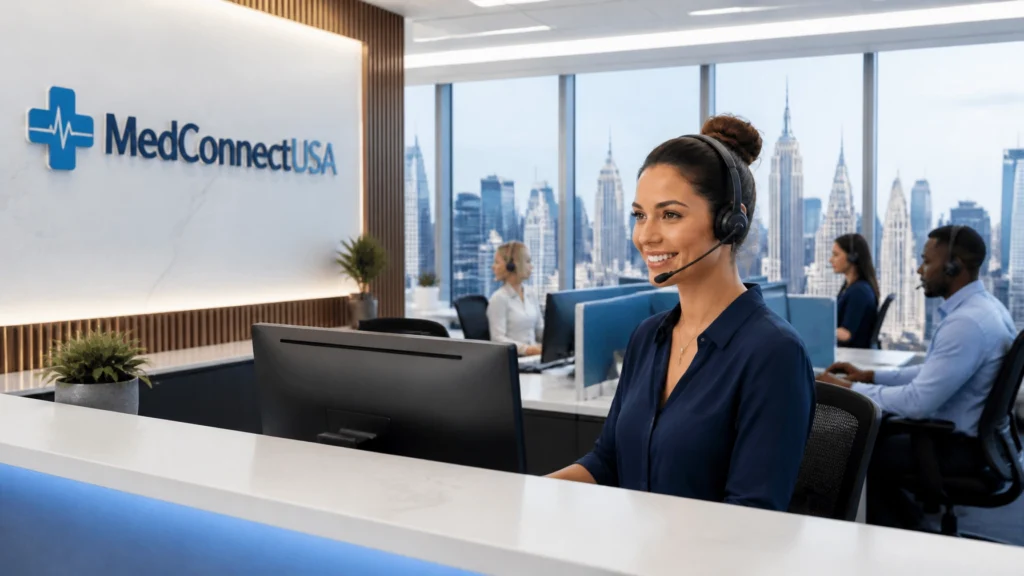
If your specialty clinic serves patients in Manhattan, Brooklyn, Queens, the Bronx, or Staten Island, a specialized medical answering service NYC strategy is usually the better fit. New York City clinics face dense patient demand, constant schedule pressure, multilingual caller needs, and little tolerance for long wait times. A specialized physician answering service helps you protect access with sub-30-second hold times, 24/7 live coverage, and workflow-specific escalation paths that match the pace of the city. Compared with relying on in-house staff alone, a medical-only healthcare answering service from MedConnectUSA gives your practice more flexibility during lunch breaks, after hours, provider call rotations, and sudden surges in patient volume.
For specialty clinics, the goal isn’t just answering the phone. It’s making sure every patient reaches a calm, trained operator who knows when to route a refill request, when to document a routine message, and when to escalate an urgent clinical concern right away.
Key Takeaways
- NYC call volume demands speed: A specialized medical answering service NYC model helps your clinic maintain sub-30-second hold times even during peak surges.
- Specialty workflows matter: A trained physician answering service follows your custom protocols for urgent symptoms, on-call paging, scheduling, and message routing.
- Coverage gaps are expensive in New York City: Missed calls in Manhattan or Brooklyn often mean lost appointments, frustrated patients, and more pressure on your front desk team.
- Compliance can’t slip after hours: A medical-only healthcare answering service with HIPAA-compliant workflows and a BAA helps reduce privacy risk.
- Hybrid coverage is often the smartest choice: Your in-house team manages in-office patient flow while a specialized medical answering service supports overflow, evenings, weekends, and emergencies.
Table of Contents
- Why do NYC specialty clinics need a different call coverage strategy?
- How does a specialized medical answering service support NYC specialty workflows?
- Why is HIPAA-compliant after-hours coverage so important in New York City?
- What happens when NYC patients reach voicemail or long hold times?
- Is a hybrid model the right fit for your NYC specialty clinic?
- Real-World Scenarios: Manhattan Cardiology vs. Brooklyn Pediatrics
- Frequently Asked Questions
Why do NYC specialty clinics need a different call coverage strategy?
New York City specialty clinics operate in a different environment than suburban practices with lighter call volume. In Manhattan, one delayed callback can mean a patient books elsewhere. In Brooklyn, your front desk may be balancing walk-ins, referrals, prior authorizations, and physician messages at the same time. Across NYC, the pace is fast, expectations are high, and patients are less willing to sit through a long voicemail tree or wait on hold for several minutes.
That is why many practices move beyond an in-house-only model and add a specialized medical answering service NYC solution. A medical-only medical answering service gives you overflow support during peak hours, 24/7 live response after hours, and call handling built around healthcare workflows instead of generic business scripts.
In New York City, the issue is not just payroll cost. It is access, speed, and consistency under pressure. If your office cannot answer quickly during lunch breaks, provider clinic days, or heavy Monday morning volume, patients feel that friction immediately.
| Feature | In-House Staff Only | Specialized Medical Answering Service NYC |
|---|---|---|
| Peak-hour coverage | Limited by available front-desk staff | Built to absorb overflow immediately |
| After-hours response | Requires nights/weekends staffing or voicemail | 24/7/365 live operator coverage |
| Hold times | Can spike during surges | Designed to support sub-30s hold times |
| Specialty protocol handling | Depends on staff availability and training | Custom workflows for your practice |
| Scalability across borough demand | Hard to expand quickly | Flexible support for high patient volume |
| HIPAA processes | Varies by office setup | Secure systems, HIPAA workflows, BAA |
For many NYC clinics, the better comparison is not “staff or service.” It is “how do you protect patient access when your staff is already maxed out?” That is where a 100% medical answering service becomes operationally useful instead of optional.

How does a specialized medical answering service support NYC specialty workflows?
A busy NYC clinic cannot rely on generic call scripts. Specialty care in Manhattan, Brooklyn, Queens, the Bronx, and Staten Island often means more referrals, more urgent follow-up needs, and more patients calling between appointments. The right physician answering service does not improvise. It follows your instructions step by step.
That means your medical answering service NYC setup can be configured to:
- identify whether the caller is a patient, pharmacy, hospital, lab, or referring provider
- separate appointment requests from urgent symptom calls
- route refill requests according to office policy
- escalate time-sensitive issues to the on-call provider
- document messages securely for next-business-day follow-up
- support overflow when your front desk is tied up with in-person traffic
For example, if a Manhattan cardiology patient calls after hours with chest pressure and shortness of breath, a trained operator does not treat that like a routine message. They follow a defined medical answering service best practices workflow based on your protocol, which may include directing the patient to call 911 and immediately paging the on-call physician. If a Brooklyn dermatology patient calls about a biopsy follow-up question, that same healthcare answering service can log and route the message securely for the next clinical response window.
Since MedConnectUSA has worked as a medical-only provider since 1991, with 100% U.S.-based operators and HIPAA-aware workflows, your patients get a more precise response than they would from a general answering vendor. That precision helps your clinic stay organized as patient demand keeps rising.
Why is HIPAA-compliant after-hours coverage so important in New York City?
In a city where your practice may receive high call volume before clinic opens, during lunch, after hours, and throughout weekends, privacy controls cannot break down when the schedule gets busy. Yet that is exactly what can happen when internal staff rely on personal phones, informal texting, handwritten notes, or inconsistent message relay processes.
A professional HIPAA compliant answering service creates structure around those pressure points. At MedConnectUSA, we provide a Business Associate Agreement (BAA), encrypted communication options, secure message handling, and trained operators working in controlled U.S.-based call center environments. You can learn more about how we protect patient privacy and why that matters when your call flow includes labs, hospitals, pharmacies, and urgent patient concerns.
For NYC specialty clinics, that matters because speed and compliance have to exist together. You need fast call pickup, but you also need documented workflows, secure routing, and a team that understands the difference between a routine scheduling request and a protected health information event. A specialized medical answering service helps you maintain both standards at once.
What happens when NYC patients reach voicemail or long hold times?
In New York City, voicemail is often where patient loyalty starts to break down. If a new patient in Manhattan calls your specialty clinic and gets stuck in a queue, they may move on to the next provider before your staff can call back. If an established patient in Brooklyn calls with a post-procedure concern and hears a recording, that patient may feel ignored at the exact moment they need reassurance.
That is why live response matters. A specialized medical answering service NYC helps your practice keep calls moving with real operators, not a confusing maze of prompts. With sub-30-second hold times, your patients hear a calm and steady voice quickly, which lowers frustration and helps them feel prioritized and respected. That experience is a major reason a live healthcare answering service supports patient retention in busy practices.
For specialty clinics, the patient experience impact is practical:
- fewer abandoned calls
- fewer missed new-patient opportunities
- less front-desk overload
- clearer urgent message routing
- more confidence that after-hours calls are being handled correctly

Is a hybrid model the right fit for your NYC specialty clinic?
For many New York City practices, yes. A hybrid setup lets your in-house team stay focused on the patients physically in front of them while a specialized medical answering service protects call coverage behind the scenes.
Here is what that often looks like in practice:
- Daytime Overflow: During lunch breaks, referral surges, provider clinic blocks, or Monday morning spikes, your medical answering service NYC coverage picks up overflow calls before they become missed opportunities.
- After-Hours Coverage: When your office closes, the physician answering service continues handling patient calls, urgent escalations, and on-call messaging based on your protocol.
- Weekend and Holiday Continuity: Specialty clinics still receive refill requests, symptom concerns, and hospital callbacks outside normal hours. Live coverage keeps those communications organized.
- Disaster Recovery: If severe weather, transit disruptions, local outages, or internal phone issues affect your office, your phones can still be answered through redundant systems.
This approach reduces front-desk burnout without sacrificing responsiveness. It also gives your patients a more consistent experience whether they call from Midtown, Park Slope, Queens, or anywhere else in the city. If you want a clearer picture of how that support works, review these 10 key services offered by medical answering services and see how an after-hours medical answering service fits your workflow.
Real-World Scenarios: Manhattan Cardiology vs. Brooklyn Pediatrics
Scenario A: The Manhattan Cardiology Surge
A Manhattan cardiology clinic finishes a hospital-affiliated screening event and sees a same-day spike in calls from new patients, referring providers, and existing patients asking about follow-up availability. The front desk is already handling check-ins, insurance questions, and stress-test scheduling. Without a specialized medical answering service NYC setup, hold times climb and callers start dropping off.
With MedConnectUSA, overflow calls route to trained operators who answer in your practice name, capture key details, follow your protocol, and deliver urgent messages securely. Your internal team stays focused on in-office operations while your callers still get a live response in under 30 seconds.
Scenario B: The Brooklyn Pediatric After-Hours Call
At 11:00 PM, a parent in Brooklyn calls your pediatric specialty clinic because their child has a high fever and worsening symptoms. Voicemail would increase panic. A generic call center might not recognize the urgency. A specialized physician answering service answers immediately, follows the clinic’s after-hours workflow, documents the concern clearly, and pages the on-call pediatrician through a secure process. The parent feels supported, and your provider receives an organized, actionable message.
These are the moments when a medical-only healthcare answering service proves its value. It does not just answer calls. It protects patient access when timing and clarity matter most.
Frequently Asked Questions
Q: Is a medical answering service NYC solution only useful for very large practices?
A: No. Even smaller specialty clinics in Manhattan, Brooklyn, Queens, the Bronx, or Staten Island can benefit from overflow and after-hours support. If your staff is juggling phones, in-office patients, referrals, and provider messages, a specialized medical answering service can reduce pressure quickly.
Q: Can your operators support physician on-call workflows?
A: Yes. Our physician answering service follows your escalation instructions for on-call physicians, urgent patient concerns, hospitals, labs, and pharmacies. We do not use a one-size-fits-all script.
Q: Are your operators based in the United States?
A: Yes. MedConnectUSA is 100% U.S.-based. Our operators work in secure call center environments, not outsourced overseas locations, which supports consistency, accountability, and patient communication quality.
Q: Do you offer HIPAA-compliant coverage for after-hours calls?
A: Yes. Our HIPAA compliant answering service workflows include secure processes, encrypted communication options, and a Business Associate Agreement (BAA) when appropriate.
Q: Can a healthcare answering service help us maintain faster hold times?
A: Yes. One of the main reasons practices use a specialized healthcare answering service is to reduce voicemail, abandoned calls, and long wait times. MedConnectUSA supports sub-30-second hold times so your patients get a faster live response.
Managing patient communication in New York City requires more than good intentions. It requires a workflow that keeps up with high call volume, urgent escalations, borough-wide patient demand, and the expectation that someone competent will answer quickly. That is where a specialized medical answering service NYC model stands apart from an in-house-only approach.
If your specialty clinic needs better overflow coverage, cleaner physician message routing, stronger after-hours continuity, and a calmer patient experience, a medical-only partner can help you build a more dependable call process. You can also explore our medical answering service, healthcare answering service, and physician answering service solutions to compare what fits your workflow best.
When you are ready to evaluate a solution tailored to your practice, talk to a specialist.