

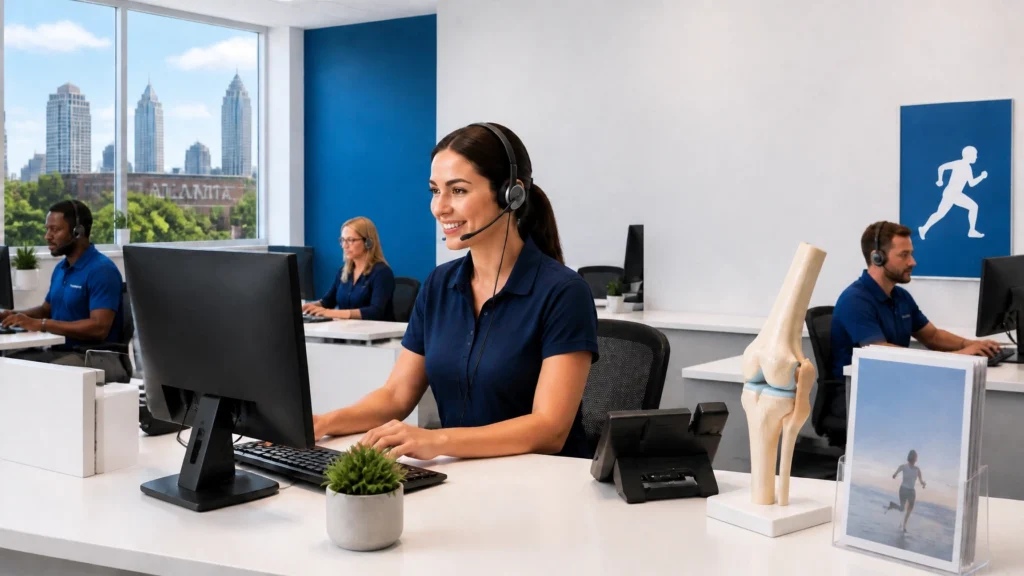
If you run an orthopedic practice in Atlanta, high call volume is usually a daily operations problem, not an occasional inconvenience. Between surgery scheduling, referrals, urgent injury calls, imaging coordination, insurance questions, and post-op concerns, your front desk can get overwhelmed fast. A medical call center service helps you manage that volume by answering calls live, following your workflows, routing urgent messages correctly, and giving patients a better experience without overloading your in-house staff. For busy metro Atlanta orthopedic groups, a medical-only answering service is especially useful when you need after-hours coverage, overflow support during clinic rushes, and reliable handling of surgical scheduling and post-op calls.
Table of Contents
- Key Takeaways
- Why do Atlanta orthopedic practices struggle with high call volumes?
- How does a medical call center service help orthopedic specialists in Atlanta?
- What should your orthopedic answering service handle during surgery scheduling and post-op recovery?
- How does a medical-only answering service compare to voicemail or a general call center?
- What does this look like in real orthopedic practice scenarios?
- Why do workflow, compliance, and reliability matter in healthcare answering services?
- FAQ
Key Takeaways
- Atlanta orthopedic practices often face concentrated call spikes tied to commuter schedules, same-day injury demand, surgical scheduling, and post-op follow-up needs.
- A medical call center service helps you answer more calls live, reduce front-desk overload, and route urgent orthopedic concerns using your instructions.
- A specialized orthopedic answering service can support appointment intake, after-hours triage escalation, surgery-related coordination, and post-op message handling.
- Compared with voicemail or a generic vendor, medical-only healthcare answering services give you better workflow fit, stronger patient experience, and more dependable escalation.
- MedConnectUSA provides medical answering service support with operational proof points that matter to healthcare organizations: medical-only since 1991, 100% U.S.-based agents, HIPAA-conscious workflows, BAA availability, and average hold times under 30 seconds.
- This Friday Sniper City blog stays tightly focused on Atlanta orthopedic demand, including metro traffic patterns, sports injury surges, and patient communication expectations around major care corridors such as Buckhead, Midtown, and the Perimeter area.
Why do Atlanta orthopedic practices struggle with high call volumes?
Atlanta’s orthopedic practices are busy for predictable reasons. You’re serving a large metro population with heavy commuter traffic, active families, student athletes, aging adults, workers with repetitive-use injuries, and patients moving through pre-op and post-op care pathways. That creates a steady mix of urgent and routine calls all day long.
Your call patterns may look like this:
- Early-morning appointment change requests from patients trying to avoid traffic on I-285 or GA-400
- Midday referral and insurance calls while your team is checking in clinic patients
- Late-afternoon surgery questions from patients who finally have time to call after work
- Evening and weekend post-op calls about swelling, pain medication timing, dressings, or mobility concerns
- Monday morning surges after youth sports injuries, falls, and weekend urgent care referrals
That’s why many groups add a medical answering service or dedicated overflow support instead of expecting the front desk to absorb every spike. In orthopedics, the issue usually isn’t just call quantity. It’s the mix of urgency, detail, and timing.

How does a medical call center service help orthopedic specialists in Atlanta?
A medical call center service gives your practice another layer of trained support without forcing every call through voicemail or interrupting staff who are already handling patients in the office. The right partner functions like an extension of your practice, not a generic message line.
For Atlanta orthopedic specialists, that can include:
- Live answering during peak daytime overflow
- After-hours and weekend coverage
- New patient intake for sports injuries and specialist referrals
- Call screening based on orthopedic-specific urgency
- Message capture for imaging, prescription, brace, DME, or physical therapy questions
- Routing surgical scheduling messages to the correct coordinator
- Escalating post-op concerns using your on-call workflow
If you use a daytime hours answering service, you reduce the pressure on your internal staff during check-in rushes, procedure blocks, and lunch coverage. If you add an after-hours medical answering service, you also protect the patient experience when your office is closed but your patients still need help.
The biggest benefit is operational control. Your workflows stay yours. The service follows your scripts, your escalation rules, your scheduling pathways, and your on-call instructions so patients get a consistent experience.
What should your orthopedic answering service handle during surgery scheduling and post-op recovery?
An orthopedic answering service should be able to support the parts of your workflow that create the most pressure for staff and the most anxiety for patients.
Surgery scheduling support
Orthopedic surgery scheduling often involves more than picking a date. Your team may be coordinating:
- Procedure readiness questions
- Pre-op paperwork
- Referral documentation
- Insurance and authorization follow-up
- Facility timing changes
- Patient call-backs for arrival instructions
- Questions about braces, equipment, or recovery timelines
When those calls stack up, your surgery coordinators lose time and patients feel ignored. A medical-only answering service can capture the right details, route messages correctly, and prevent low-priority calls from burying time-sensitive ones.
Post-op call handling
Post-op callers usually need fast reassurance or a fast escalation path. They may be asking about:
- Incision appearance
- Swelling and pain expectations
- Medication timing
- Fever concerns
- Dressing issues
- Mobility questions
- Follow-up appointment timing
This is where a HIPAA compliant answering service matters. The goal isn’t for the operator to give clinical advice beyond your approved process. The goal is to document the concern accurately, identify urgency, and route the message based on your instructions.

How does a medical-only answering service compare to voicemail or a general call center?
For orthopedic practices in Atlanta, the difference usually comes down to patient experience, accuracy, and speed.
| Option | What happens for your practice | Best fit | Main risk |
|---|---|---|---|
| Voicemail | Patients leave messages and wait for a callback | Very low call volume environments | Delays, patient frustration, missed urgent details |
| General call center | Calls are answered live, but staff may not understand orthopedic workflows | Basic non-medical overflow | Inconsistent terminology, weak escalation, poor message quality |
| Medical-only answering service | Calls are answered live by teams focused on healthcare workflows | Orthopedic groups with surgery, post-op, and urgent call complexity | Requires protocol setup, but delivers stronger fit |
A medical-only provider is usually better suited for orthopedic communication because the workflow is not generic. Calls about a possible DVT symptom, cast issue, post-op fever, or next-day fracture evaluation should not be handled the same way as a retail inquiry.
That’s also why many practices choose a specialized healthcare answering service or orthopedic answering service instead of a one-size-fits-all vendor.
What does this look like in real orthopedic practice scenarios?
Real-world call handling matters more than marketing language. Here are a few examples of how healthcare answering services support orthopedic specialists in Atlanta and nationwide.
Scenario 1: Monday morning sports injury rush
It’s 8:12 AM. Your clinic has a full schedule, your front desk is checking in post-op patients, and several parents are calling about football, soccer, and basketball injuries from the weekend. A medical call center service answers overflow calls live, captures symptoms, and routes urgent appointment requests so your staff can keep the office moving.
Scenario 2: Evening post-op concern
At 7:48 PM, a patient calls about increased redness and drainage after knee surgery. Instead of hitting voicemail, the patient reaches a live operator who follows your after-hours script, confirms the callback number, identifies the concern as urgent based on your protocol, and escalates the message to the on-call provider.
Scenario 3: Surgical scheduling bottleneck
Your surgery coordinator is on the phone with a hospital scheduler while three inbound callers need information about arrival times, paperwork, and a rescheduled follow-up. A trained orthopedic answering service captures each call accurately and routes the messages by priority, which keeps your coordinator focused and prevents missed details.
Scenario 4: Storm or office outage
A summer storm disrupts power at your office. Your physical location may be offline, but calls still need to be answered. With disaster recovery and secure messaging workflows in place, patient communication continues without the office going silent.

Why do workflow, compliance, and reliability matter in healthcare answering services?
Orthopedic communication can move quickly from routine to urgent. That’s why the right medical answering service should be built around workflows, not just call volume.
You should look for operational proof points such as:
- Medical-only service since 1991
- 100% U.S.-based operators
- HIPAA-aware processes and BAA availability
- Average hold times under 30 seconds
- Secure call handling and message delivery
- Reliable backup and continuity support for outages and emergencies
These details affect daily performance. If your answering partner can’t follow your escalation tree, document messages cleanly, or maintain continuity during disruptions, your staff ends up doing rework and your patients feel the gap.
That’s why many orthopedic groups prefer a HIPAA compliant answering service, a medical answering service, or broader healthcare answering services that are designed specifically for healthcare communication.
FAQ
Do Atlanta orthopedic practices really need a medical-only answering service?
If your team deals with surgery scheduling, urgent injury calls, and post-op communication, a medical-only answering service is usually a better fit than voicemail or a generic provider. Orthopedic calls often require accurate detail capture and priority-based routing.
Can a medical call center service help during normal business hours, not just after hours?
Yes. Many orthopedic practices use a medical call center service for daytime overflow when staff are busy with check-ins, clinic flow, procedure support, or other front-office work.
What kinds of calls can an orthopedic answering service handle?
An orthopedic answering service can typically handle new patient intake, overflow calls, urgent message capture, surgery scheduling support, referral communication, and post-op call routing based on your protocols.
Is this useful for practices in Atlanta only?
No. MedConnectUSA supports practices in Atlanta and nationwide. The benefit for Atlanta groups is that the service can help manage metro-area call spikes and patient expectations without implying a local office presence.
What should you ask before choosing among healthcare answering services?
Ask how the service handles escalation, secure messaging, operator training, average speed to answer, U.S.-based staffing, BAA availability, and after-hours orthopedic workflows.
If your Atlanta orthopedic practice is dealing with busy phones, overextended staff, and patients who expect faster answers, a specialized medical answering service can give you a more stable workflow without changing how your practice delivers care. It creates room for your front desk, protects your surgery coordinators’ time, and helps your patients feel supported before and after treatment.
If you want to see how a medical-only, workflow-driven partner can support orthopedic scheduling, overflow, and post-op communication, talk to a specialist