

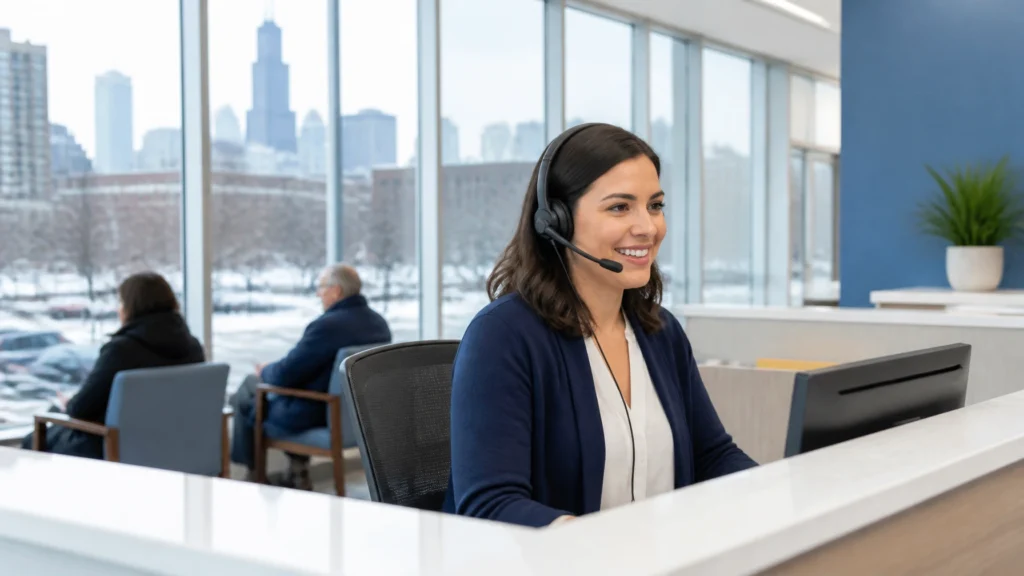
If you’re comparing a medical answering service Chicago practices can rely on, prioritize live healthcare-trained operators, 24/7 coverage, HIPAA-conscious workflows, secure message routing, and continuity during call spikes, not a generic voicemail system. The best partner supports your practice during lunch breaks, meetings, overflow periods, evenings, weekends, holidays, winter storms, and transit disruptions while following your exact instructions.
MedConnectUSA provides live medical answering support nationwide from secure U.S.-based centers. We’re not presenting ourselves as a Chicago office. Instead, we’re serving medical practices in Chicago with medical-only communication support, customized protocols, and 24/7/365 coverage.
Table of Contents
- What should you look for in a medical answering service Chicago practices can trust?
- How does live answering support Chicago patient access?
- Can a medical answering service handle daytime overflow and call spikes?
- How does secure message routing protect continuity of care?
- How does coverage help during Chicago winter disruptions?
- How does MedConnectUSA compare with other answering options?
- What questions should you ask before choosing a provider?
- Frequently Asked Questions
Key Takeaways
- The best medical answering service Chicago practices choose combines live operators, healthcare-specific training, secure communications, and customized call protocols.
- Coverage should support both after-hours calls and daytime overflow when your staff is in appointments, meetings, or handling a sudden call surge.
- Chicago’s dense healthcare environment, from the Illinois Medical District to major ambulatory-care corridors, creates high expectations for responsive patient communication.
- Winter snow, ice, road congestion, and CTA disruptions can make phone access especially important for rescheduling and care coordination.
- MedConnectUSA provides nationwide support from secure U.S.-based centers and has operated as a medical-only answering service since 1991.
What should you look for in a medical answering service Chicago practices can trust?
A reliable provider should do more than answer with your practice name. It should understand how healthcare calls move through your workflow.
Look for a partner that can:
- Identify your practice and the caller.
- Determine whether the call concerns scheduling, a routine message, a refill request, a referral, or an urgent issue.
- Follow your instructions for collecting accurate details.
- Route messages through a secure delivery method.
- Escalate time-sensitive calls according to your on-call schedule.
- Document what happened so your team can act without repeating the conversation.
This workflow matters because patients often call when they’re already frustrated. They may be trying to reach someone after a long workday, confirm an appointment before traveling, or understand what to do when symptoms change. A confusing maze of voicemail prompts can make them feel dismissed. A calm and steady voice helps them feel prioritized and respected.
When you evaluate a healthcare answering service, ask whether the provider works exclusively with medical organizations. Medical-only experience supports more precise call handling and reduces the risk of treating a patient call like a generic customer-service request.
How does live answering support Chicago patient access?
Chicago patients use a broad healthcare network that includes the Illinois Medical District, hospital-based clinics, specialty practices, community health centers, and ambulatory-care locations. The Illinois Medical District is a major healthcare and innovation hub anchored by institutions such as Rush University Medical Center, UI Health, Cook County Health, and Jesse Brown VA Medical Center. Patients expect clear communication before, during, and after an appointment.
That expectation continues beyond the medical campus. A patient may call while traveling along the I-290 corridor, waiting for a bus, heading to a neighborhood clinic, or trying to coordinate care between multiple appointments. If your team can’t answer, the patient may call again, leave incomplete information, or choose another practice.
With a medical office answering service, your patients reach a live person who follows your approved script and workflow. Depending on your configuration, operators can support:
- Appointment requests and scheduling instructions
- Cancellations and rescheduling messages
- Referral and records inquiries
- Prescription or pharmacy messages
- Provider and office information
- Routine patient communications
- Urgent escalation to your designated clinical or on-call contact
A live operator doesn’t replace your clinicians. Nurse triage and clinical decision-making remain with your qualified healthcare team. The answering service protects the communication path so the right information reaches the right person quickly.

Can a medical answering service handle daytime overflow and call spikes?
Yes, if the service is configured for more than after-hours coverage.
Many practices think about answering support only after the office closes. However, missed calls often occur during the busiest daytime periods: lunch breaks, staff meetings, patient check-ins, procedures, shift changes, and sudden call spikes caused by weather, seasonal illness, public health notices, or schedule changes.
A daytime overflow model allows your internal staff to stay focused while live operators answer calls using your instructions. Your team can choose whether calls are transferred immediately, captured as secure messages, or handled through a hybrid workflow.
| Coverage option | Best for | What it prevents |
|---|---|---|
| Full 24/7 live answering | Practices needing one consistent access point | Missed nights, weekends, and holiday calls |
| After-hours coverage | Offices with strong daytime staffing | Voicemail frustration after closing |
| Daytime overflow | Busy practices with frequent call surges | Interrupted visits and staff burnout |
| Hybrid live and voicemail support | Practices with different call priorities | Sending every call through the same path |
A practical service review should include response-time reporting. Ask whether the provider can work toward a hold-time target of less than 30 seconds, how abandoned calls are measured, and what happens when call volume suddenly increases.
MedConnectUSA’s daytime hours answering service is designed for practices that need help during the workday, not only at night. The result is a steadier front line for patients and fewer interruptions for your staff.
How does secure message routing protect continuity of care?
The value of an answering service depends on what happens after the call is answered. A message that is incomplete, sent to the wrong person, or delivered through an unsecured channel can delay care and create unnecessary follow-up work.
Your call protocol should define:
- Required patient identifiers
- The reason for the call
- The appropriate urgency level
- The responsible provider, department, or on-call contact
- The approved escalation sequence
- The secure message-delivery method
- The expected callback process
MedConnectUSA supports HIPAA-conscious processes, secure portals, encrypted communications, secure message delivery options, and personnel training aligned with healthcare privacy expectations. A Business Associate Agreement is available as appropriate for the services performed.
When comparing a HIPAA compliant answering service, ask specific operational questions. Are operators U.S.-based? Do they work in secure call centers? How are messages authenticated and delivered? Can your practice update its on-call schedule? How is continuity maintained during an outage?
These details matter to patients who don’t know your internal staffing structure. They simply need to know that their call is received carefully and passed forward reliably.
How does coverage help during Chicago winter disruptions?
Chicago winter conditions can quickly change a routine appointment day. Snow and ice may slow travel, road congestion may build near major healthcare corridors, and CTA rail or bus service may experience delays. A patient who planned to arrive on time may need to reschedule, switch to a telehealth visit when available, or ask whether the appointment should proceed.

During these disruptions, your phone line becomes part of your continuity plan. A medical answering service can follow your weather-specific instructions, such as:
- Capturing cancellation and rescheduling requests
- Explaining temporary office-hour changes
- Routing urgent messages to the appropriate contact
- Providing approved telehealth instructions
- Notifying your staff about patterns in patient calls
- Continuing coverage if your office loses power or closes unexpectedly
This is especially useful for practices connected to the Illinois Medical District, downtown ambulatory corridors, and neighborhood clinics serving patients who rely on public transportation. Patients feel less stranded when they can reach a live person, and your staff has a clearer queue when normal operations resume.
How does MedConnectUSA compare with other answering options?
| Evaluation factor | Generic answering service | AI-only phone system | MedConnectUSA |
|---|---|---|---|
| Healthcare-specific workflows | May be limited | Depends on configuration | Medical-only since 1991 |
| Live human interaction | Varies | No live operator by default | Live U.S.-based operators |
| After-hours coverage | Often available | Usually automated | 24/7/365 live coverage |
| Customized escalation | May be basic | Requires precise programming | Built around client protocols |
| HIPAA and BAA support | Must be verified | Must be verified | HIPAA-conscious processes and BAA availability |
| Daytime overflow | May be available | Handles volume but not nuance | Configurable daytime support |
| Disruption continuity | Varies | Dependent on systems | Backup and disaster-recovery readiness |
AI-powered triage and automation can help organize simple requests, but they can also struggle with unclear language, emotional callers, unusual situations, and nuanced escalation rules. Live operators provide judgment within your approved workflow and can recognize when a call needs careful clarification.
Our nationwide medical answering service operates from secure U.S.-based centers. That means your practice receives nationwide coverage without us implying a physical Chicago location.

What questions should you ask before choosing a provider?
Before selecting a medical call center service, ask for clear answers to these questions:
- Do you answer calls 24/7/365?
- Are your operators 100% U.S.-based?
- Do operators work in secure call centers rather than home-based environments?
- Can you provide a BAA when appropriate?
- How do you verify patient information?
- Can you support daytime overflow as well as after-hours calls?
- How are urgent messages escalated?
- Can you follow separate instructions for different providers or departments?
- What continuity systems are available during storms, power outages, or network disruptions?
- Can you provide reporting on call volume, response time, and message completion?
You can also review MedConnectUSA’s doctors’ office answering service and medical answering service for dental offices to see how workflows can be adapted to different healthcare settings.
Frequently Asked Questions
What is the best medical answering service Chicago practices can use?
The best provider is the one that matches your call protocols, supports secure communications, provides live coverage when patients call, and can handle both routine and urgent workflows. For many practices, 24/7/365 coverage and daytime overflow are more useful than a voicemail-only solution.
Is MedConnectUSA located in Chicago?
No. MedConnectUSA provides nationwide service from secure U.S.-based centers. We serve medical practices in Chicago without claiming to operate a physical Chicago office.
Can an after-hours medical answering service schedule appointments?
It can, when your practice enables that function and provides scheduling rules. Otherwise, operators can capture the request and route it securely to your staff.
Does a medical answering service replace nurse triage?
No. A live answering service follows your instructions and escalates clinical or urgent calls to your designated healthcare professionals. Your clinical team remains responsible for triage and medical decisions.
Can coverage continue if a practice closes during a snowstorm?
Yes, a continuity plan can include temporary closures, weather-related rescheduling, approved telehealth directions, and emergency escalation instructions. Your practice should provide and regularly update those protocols.
Why choose live operators instead of an automated system?
Live operators can clarify what a patient needs, respond with empathy, and follow a customized escalation path when a request doesn’t fit a simple menu. Automation may assist with routine tasks, but live support helps preserve trust during sensitive or urgent conversations.
When your practice is ready to compare workflows, coverage, security controls, and continuity support, talk to a specialist.